
In a world where businesses, students, travellers, healthcare providers, legal professionals, and global organisations communicate across borders every day, translation has become more important than ever. A single message may need to move from English to French, Hindi to English, Japanese to English, or across several languages while preserving its original meaning.
For quick translation, many people immediately turn to Google Translate. It is fast, convenient, widely accessible, and capable of translating words and sentences within seconds. But when accuracy, cultural understanding, confidentiality, tone, or professional credibility matters, is an automated translation tool really enough?
This is where the debate around Google Translate vs. professional human translation becomes important.
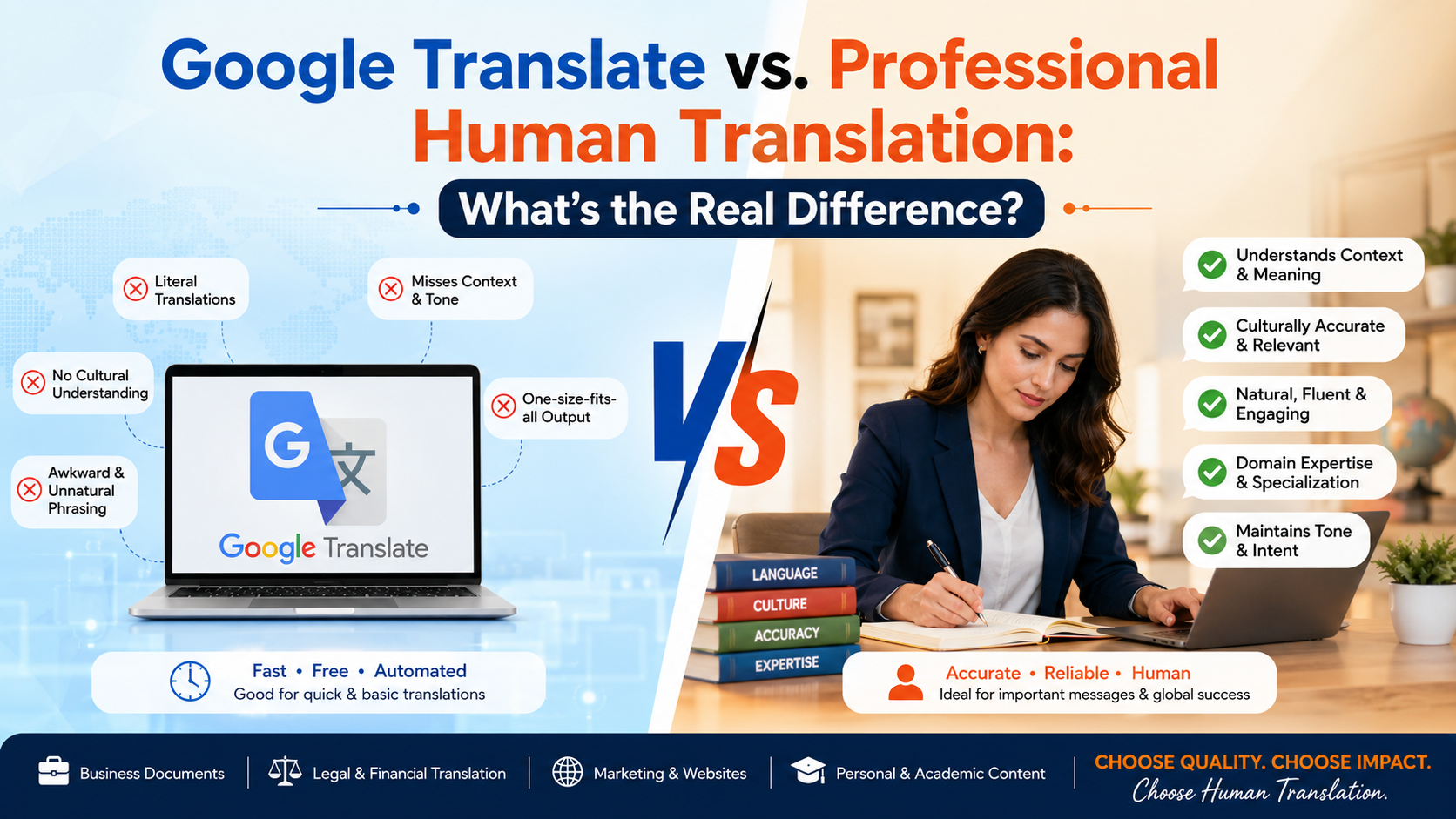
Although both options convert content from one language to another, they work in fundamentally different ways. Machine translation relies on artificial intelligence, algorithms, and large-scale language data, while a professional translator uses linguistic expertise, cultural knowledge, subject understanding, context, and human judgement.
In this detailed guide, we explore the real difference between Google Translate and human translation, when each option is useful, the limitations of AI-powered translation, and why professional language support from La Classe can be the better choice for important communication.
Looking for a trusted best apostille service in Gurugram? Our experts ensure fast and hassle-free document legalization.
What Is Google Translate?
Google Translate is an automated machine translation tool designed to convert text, speech, images, documents, and other forms of language content from one language into another.
Its biggest advantage is convenience. You enter text, select the target language, and receive a translation almost instantly. This makes it highly useful for everyday situations where speed matters more than perfect linguistic precision.
For example, Google Translate may help when you want to:
- Understand the basic meaning of a foreign-language sentence
- Translate a simple word or phrase
- Read an informal message
- Navigate basic communication while travelling
- Get the general idea of online content
- Check the rough meaning of unfamiliar vocabulary
- Translate simple, low-risk personal communication
Modern machine translation technology is significantly more advanced than older word-for-word translation systems. AI-based models can analyse patterns and produce increasingly natural sentences.
However, faster does not always mean more accurate.
Language is influenced by context, culture, intention, industry, emotion, audience, and tone. These are areas where automated translation can still face serious limitations.
Need a certified translation of academic transcripts and degree certificates? We provide accurate, university-accepted translations.
What Is Professional Human Translation?
Professional human translation is the process of translating content through a skilled language expert who understands both the source language and the target language.
A professional translator does much more than replace individual words. The translator interprets the intended meaning of the original content and recreates that meaning naturally and accurately for the target audience.
A skilled translator considers:
- Context
- Grammar
- Cultural references
- Tone of voice
- Audience expectations
- Industry terminology
- Local expressions
- Idioms
- Ambiguity
- Formality
- Brand messaging
- Emotional meaning
- Regional language differences
For example, a legal contract should not sound like a casual conversation. A marketing slogan should not read like a literal dictionary translation. A medical document requires accurate terminology, while a website may require localisation for a specific market.
This ability to understand the purpose behind words is one of the biggest advantages of human translation services.
Looking for reliable apostille services in India? We provide end-to-end assistance for all document types.
Google Translate vs. Professional Human Translation: Quick Comparison
|
Factor |
Google Translate |
Professional Human Translation |
|
Speed |
Almost instant |
Requires time for careful translation |
|
Cost |
Usually free |
Professional service fee applies |
|
Context |
Can misinterpret complex context |
Understands meaning and intention |
|
Cultural Nuance |
Limited |
Strong cultural awareness |
|
Accuracy |
Varies by language and content |
Higher for professional content |
|
Industry Terminology |
May be inconsistent |
Can use specialised terminology |
|
Tone |
Often generic |
Adapted to audience and purpose |
|
Idioms |
May translate incorrectly |
Interpreted contextually |
|
Creativity |
Limited |
Stronger for marketing and creative content |
|
Localisation |
Limited |
Can adapt content for local markets |
|
Human Review |
No |
Yes |
|
Suitability for High-Stakes Content |
Limited |
Strongly preferred |
|
Brand Voice |
May be inconsistent |
Can preserve brand personality |
The right choice depends on what you are translating and how important the final result is.
1. Accuracy: The Most Important Difference
The biggest issue in the machine translation vs. human translation debate is accuracy.
Google Translate can perform well with simple and direct sentences. For instance:
“The meeting starts at 10 AM.”
A straightforward sentence like this has limited ambiguity, so automated translation may produce a useful result.
But consider a sentence such as:
“We need to address the issue before it gets out of hand.”
The phrase “gets out of hand” is not meant literally. A machine translation system must recognise that it means a situation becoming difficult to control.
A professional human translator understands the intended meaning and selects an equivalent expression that sounds natural in the target language.
This becomes especially important for:
- Legal translation
- Medical translation
- Financial translation
- Technical translation
- Business documents
- Academic content
- Official certificates
- Marketing campaigns
- International communication
When one incorrect word can change the meaning of an entire document, relying only on automatic translation may create unnecessary risk.
- Our professional document translation services ensure linguistic accuracy and global acceptance.
Need accurate translation for important content?
Choose professional language expertise instead of leaving critical meaning to chance.
Contact La Classe today for professional translation support.
Visit Us:
F-126, Aditya Arcade, Preet Vihar, Delhi-110092
Call Us:
011-4304 8424 / +91-99582 98424
Email Us:
manohar.roshan@laclasse.in
2. Context: Humans Understand What Words Really Mean
One word can have multiple meanings.
Take the English word “bank.” It may refer to:
- A financial institution
- The side of a river
- An action involving an aircraft turning
- A place where something is stored
A translation tool must predict the intended meaning based on available text. In simple sentences, this may work well. In ambiguous or specialised content, errors can occur.
Human translators use the entire context.
They ask:
- What is the subject?
- Who is speaking?
- Who is the audience?
- What happened before this sentence?
- Is the tone formal or informal?
- Does the word have a technical meaning?
- Is there a cultural reference involved?
This contextual understanding is one of the key reasons why professional translation services remain essential despite rapid advances in AI.
- Confused between certified vs notarized translation? Understand which service is required for your documents.
3. Cultural Nuance and Local Understanding
Translation is not only about language. It is also about culture.
A phrase that sounds humorous in one country may sound confusing in another. A marketing slogan that works in English may lose its impact when translated literally into French, German, Japanese, Spanish, Arabic, or Hindi.
Professional translators can identify cultural differences involving:
- Humour
- Social etiquette
- Formality
- Greetings
- Symbolism
- Local customs
- Regional vocabulary
- Sensitive expressions
- Consumer expectations
This is especially important for businesses entering international markets.
Imagine launching an advertising campaign with a slogan that is grammatically translated but culturally inappropriate. Even if every individual word appears technically correct, the campaign may fail to connect with the audience.
A human translator can adapt the message while preserving its original purpose.
This process is often associated with translation and localisation services.
4. Tone and Emotion: Can AI Truly Understand Intent?
Consider these statements:
- “Could you please send the document?”
- “Send the document.”
- “Would you mind sharing the document when convenient?”
All three communicate a similar basic request, but their tone is different.
One may sound polite, another direct, and another highly considerate.
Google Translate may convert the literal meaning, but preserving the exact emotional and professional tone across languages can be difficult. This becomes particularly important for:
- Business emails
- Customer service communication
- Speeches
- Personal letters
- Luxury brand content
- Diplomatic communication
- Advertising campaigns
- Website copy
- Social media marketing
A professional translator can choose vocabulary based on the desired relationship between the speaker and the audience.
That difference can determine whether a message sounds natural, respectful, persuasive, or awkward.
- Looking for reliable translation and interpretation services in India? We provide expert language solutions for individuals and businesses.
5. Idioms and Expressions: A Major Challenge for Machine Translation
Every language contains expressions that cannot always be translated word for word.
Examples in English include:
- Break the ice
- Hit the nail on the head
- Under the weather
- Spill the beans
- Cost an arm and a leg
- Once in a blue moon
A literal translation may sound strange or completely change the intended meaning.
A professional translator recognises an idiom and searches for:
- A culturally equivalent expression in the target language, or
- A natural sentence that communicates the intended meaning
This is a major advantage of human translation over machine translation.
6. Specialised Industry Terminology
General language and professional terminology are not the same.
A word may have one meaning in everyday conversation and another in:
- Medicine
- Law
- Engineering
- Finance
- Information technology
- Manufacturing
- Education
- Pharmaceuticals
- Tourism
- International trade
For example, medical terminology demands precision. Legal terminology may have jurisdiction-specific implications. Technical manuals require consistency across repeated terms.
A professional translator with relevant subject knowledge can maintain terminology throughout a document.
This is why organisations often prefer specialised translation services for important projects rather than depending entirely on a free online translator.
- Planning to study overseas? Learn how to translate academic certificates for study abroad the right way.
7. Google Translate Is Faster — But Speed Is Not Everything
There is no denying the speed advantage of Google Translate.
For quick communication, this is extremely valuable. If you are travelling and want to understand a restaurant sign, ask a basic question, or identify the general meaning of a short sentence, an instant translation tool may be sufficient.
But professional translation prioritises more than speed.
A quality translation process may include:
- Reading the source material
- Understanding context
- Researching terminology
- Translating the content
- Reviewing language consistency
- Correcting grammar
- Improving natural flow
- Checking formatting
- Proofreading the final version
This takes longer, but for important communication, the additional care can make a substantial difference.
The real question is not simply:
“Which option is faster?”
It is:
“How important is it that this translation is accurate, natural, and appropriate?”
8. Human Translation Preserves Brand Voice
Every successful brand has a personality.
A brand may be:
- Professional
- Friendly
- Youthful
- Premium
- Technical
- Bold
- Inspirational
- Minimalist
- Playful
When businesses expand into multilingual markets, maintaining that personality becomes a challenge.
A literal translation may preserve words but lose the brand voice.
For example, a premium hospitality company may require elegant and refined language. A technology startup may prefer concise and energetic communication. An educational organisation may need clear and reassuring language.
Professional translators can adapt:
- Website copy
- Product descriptions
- Advertising campaigns
- Social media content
- Corporate presentations
- Brochures
- Email campaigns
- Brand guidelines
This is where professional language translation becomes part of a broader international communication strategy.
- Learn how to get a Polish sworn translation for visa, immigration, legal, and academic documents.
9. Translation vs. Localisation: Why the Difference Matters
Translation focuses on converting meaning from one language to another.
Localisation goes further.
It adapts content for a specific region, country, or cultural audience. This may include:
- Date formats
- Currency
- Measurement units
- Local vocabulary
- Regional spelling
- Cultural references
- Images
- Calls to action
- Consumer expectations
For example, English used in India, the United Kingdom, and the United States may differ in vocabulary, spelling, tone, and cultural expectations.
A professional translator can identify these distinctions and adapt the content accordingly.
This is particularly valuable for companies seeking website translation services, business translation services, and international market expansion.
10. Can Google Translate Replace Professional Translators?
For many important tasks, the practical answer is no.
Google Translate is useful, powerful, and increasingly sophisticated. It can assist people in understanding unfamiliar languages and overcoming basic communication barriers.
But professional translators bring capabilities that automated systems may not consistently replicate:
- Human judgement
- Cultural intelligence
- Contextual interpretation
- Subject expertise
- Creative adaptation
- Emotional sensitivity
- Audience awareness
- Responsibility for quality
The better question is not whether machine translation is “good” or “bad.” The better question is whether it is suitable for your specific purpose.
For casual understanding, it may be excellent.
For high-value professional communication, human expertise is often the stronger option.
- Looking for reliable translation services in Preet Vihar? We provide certified translations for personal, academic, legal, and business documents.
When Should You Use Google Translate?
Google Translate may be appropriate when:
- You need the basic meaning of a sentence
- You are translating casual personal text
- The content carries little risk
- You need immediate assistance
- You are checking unfamiliar vocabulary
- You are travelling
- You only need a rough translation
In these situations, speed and convenience may be more important than perfect accuracy.
When Should You Choose Professional Human Translation?
Consider a professional translator when working with:
- Legal documents
- Medical records
- Business agreements
- Corporate communication
- Technical manuals
- Academic documents
- Marketing campaigns
- Website localisation
- Product information
- Financial reports
- Official documents
- International business communication
- High-value customer content
- Brand messaging
If a translation can affect reputation, understanding, compliance, business decisions, customer trust, or professional credibility, human review becomes highly valuable.
- Choose our professional apostille services in India for educational, personal, and commercial documents.
Why Choose La Classe for Professional Translation Services?
When your message matters, translation should do more than replace words. It should communicate meaning accurately and naturally.
La Classe supports individuals, professionals, and organisations looking for reliable language and translation assistance. With a focus on communication quality and linguistic understanding, La Classe helps bridge language gaps for diverse needs.
Choosing professional support can help you achieve:
- Clear multilingual communication
- Better contextual accuracy
- Natural language flow
- Greater cultural relevance
- Professional presentation
- Improved audience understanding
- Consistent terminology
- More confident international communication
Whether you need support for business content, professional documents, multilingual communication, or other language requirements, La Classe can help you explore a more reliable approach than depending solely on automated output.
Ready to communicate beyond language barriers?
Connect with La Classe today and discuss your translation requirements.
Visit Us:
F-126, Aditya Arcade, Preet Vihar, Delhi-110092
Call Us:
011-4304 8424 / +91-99582 98424
Email Us:
manohar.roshan@laclasse.in
Frequently Asked Questions About Google Translate vs. Human Translation
1. Is Google Translate 100% accurate?
No automated translation system should be assumed to be 100% accurate for every language pair, sentence, context, or subject. Performance can vary depending on language complexity, ambiguity, terminology, and the amount of context available. For critical content, professional review is advisable.
2. Is human translation better than Google Translate?
For complex, specialised, culturally sensitive, creative, or high-stakes content, professional human translation is generally the stronger choice because a translator can consider context, audience, tone, terminology, and cultural meaning.
3. When is Google Translate useful?
Google Translate is useful for quick understanding, basic phrases, travel situations, vocabulary checks, informal communication, and low-risk content where a rough translation is sufficient.
4. Why do businesses need professional translation services?
Businesses need professional translation to communicate clearly with international customers, maintain brand voice, adapt content for local audiences, improve credibility, and reduce misunderstandings in important documents.
5. What is the main difference between machine translation and human translation?
Machine translation uses algorithms and AI-based language models to generate translations automatically. Human translation relies on a skilled translator who interprets meaning, context, tone, culture, and audience expectations.
6. Can Google Translate handle legal documents?
It may provide a rough understanding of some text, but legal documents often contain specialised terminology, nuanced obligations, and context-dependent language. Important legal content should receive appropriate professional translation and review.
7. Is professional translation worth the cost?
For important business, legal, medical, academic, technical, marketing, or official content, professional translation can be worth the investment because accuracy and clarity may directly affect decisions, trust, and reputation.
8. What is translation localisation?
Localisation adapts translated content for a specific market or region. It may adjust currency, dates, units, expressions, terminology, cultural references, and other audience-specific elements.
9. Can AI replace human translators completely?
AI can automate many translation tasks and assist language professionals, but human expertise remains especially valuable when content requires judgement, cultural interpretation, creativity, specialised knowledge, or sensitivity.
10. How do I choose between Google Translate and professional translation?
Consider the purpose and risk. If you only need a rough understanding, machine translation may be enough. If accuracy, professionalism, brand reputation, cultural nuance, or specialised terminology matters, choose professional human translation.
11. Where can I find professional translation services in Preet Vihar, Delhi?
If you are looking for professional language and translation assistance in Preet Vihar, you can contact La Classe at F-126, Aditya Arcade, Preet Vihar, Delhi-110092 to discuss your requirements.
12. How can I contact La Classe for translation support?
You can call La Classe at 011-4304 8424 or +91-99582 98424, email manohar.roshan@laclasse.in, or visit F-126, Aditya Arcade, Preet Vihar, Delhi-110092.
Final Verdict: Google Translate or Professional Human Translation?
The choice between Google Translate and professional human translation depends on the purpose of your content.
Google Translate is a remarkable tool for speed, accessibility, and basic understanding. It can be extremely useful for travellers, students, casual users, and anyone who needs a quick idea of what unfamiliar text means.
Professional human translation serves a different purpose.
When context matters, when your brand reputation is involved, when specialised terminology must be accurate, when cultural nuance affects interpretation, or when your audience expects polished communication, human expertise provides substantial value.
The real difference is not simply technology vs. people.
It is instant output vs. contextual judgement, literal conversion vs. meaningful communication, and general understanding vs. purpose-driven translation.
For important communication, words should not merely be converted. They should be understood.
Get Professional Translation Support from La Classe
Looking for reliable language and translation assistance in Delhi? Connect with La Classe and discuss your specific requirements.
Visit Us:
F-126, Aditya Arcade, Preet Vihar, Delhi-110092
Call Us:
011-4304 8424 / +91-99582 98424
Email Us:
manohar.roshan@laclasse.in
Take the next step towards clearer, more accurate, and more effective multilingual communication with La Classe.