
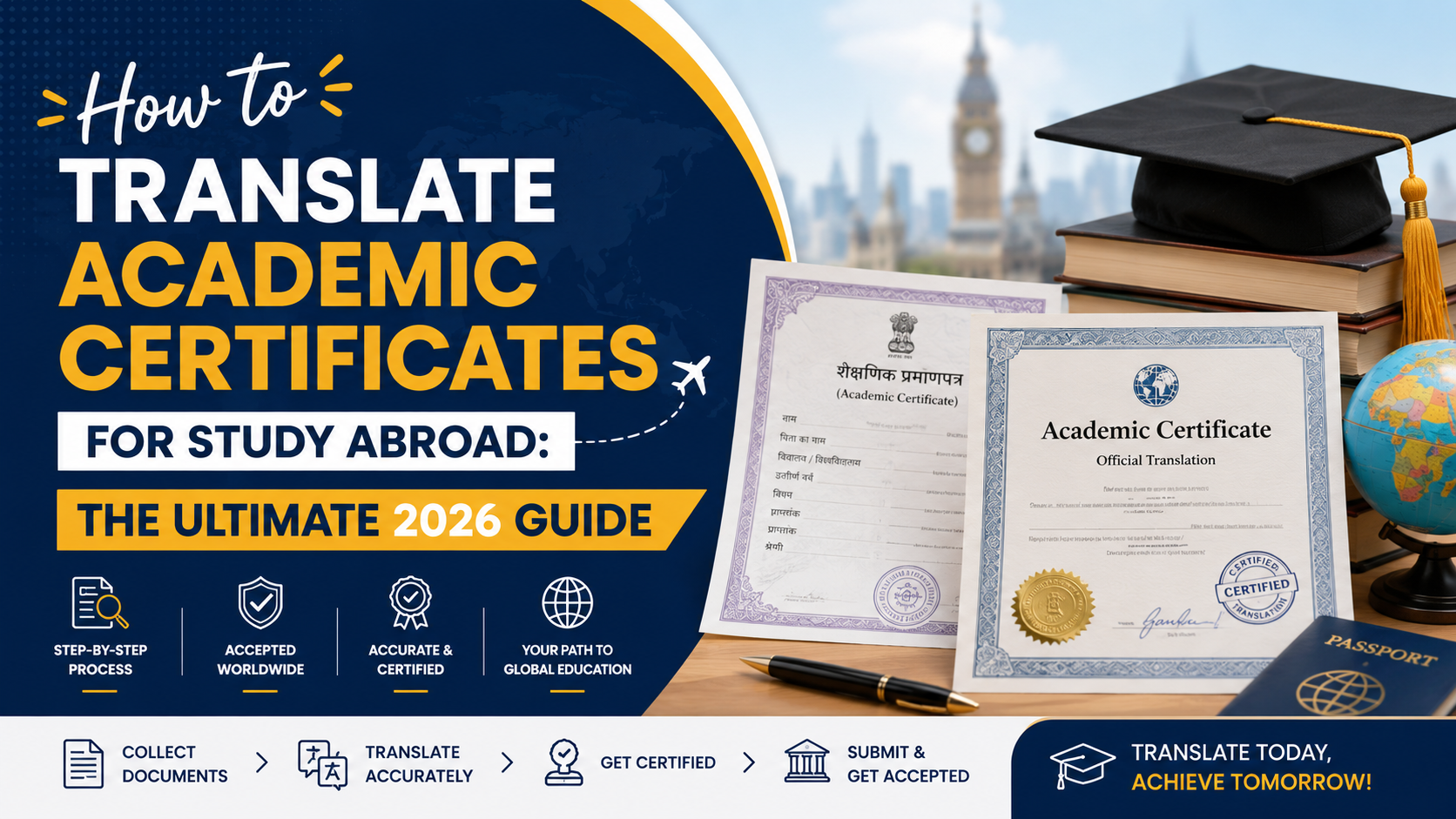
Dreaming of studying in Germany, France, Canada, Australia, or the USA? Before you submit a single application, there's one critical task that can make or break your entire study abroad journey — getting your academic certificates translated correctly, completely, and officially. This in-depth guide covers everything you need to know about academic document translation for international university applications, from what documents need translation to country-specific requirements, common pitfalls, and how to choose the right translation partner.
Why Academic Certificate Translation Is Non-Negotiable for Study Abroad
Every year, thousands of Indian students lose admission opportunities, face visa rejection, or experience costly delays in their study abroad plans — not because of poor academic scores, but because of incorrectly translated or improperly authenticated documents.
When you apply to a foreign university, the admissions office, credential evaluation body, and immigration authority all need to understand exactly what qualifications you hold, what subjects you studied, what grades you earned, and from which institution. If your documents are in Hindi, Tamil, Bengali, or any other Indian language, they are simply unreadable to foreign officials who do not speak those languages.
This is why certified academic certificate translation is not a formality — it is a fundamental part of your international application.
How to Get a Polish Sworn Translation in India
Here is what is at stake if you get it wrong:
- University application rejection due to non-compliant documents
- Student visa denial for submitting uncertified or improperly translated records
- Credential evaluation failure if transcripts don't match expected formats
- Financial loss from application fees paid on rejected submissions
- Missing application deadlines while waiting for re-translation and re-authentication
- Legal complications if translated documents are later found to be inaccurate
The good news? Getting your academic documents translated professionally and correctly is entirely manageable — if you know what to do and work with the right people.
Which Academic Documents Need to Be Translated?
This is one of the most frequently asked questions among first-time study abroad applicants. The answer depends on your destination country, the university you are applying to, and the level of study. However, there is a core set of documents that almost universally require certified translation.
Academic Transcripts (Marksheets)
Your semester-wise or year-wise marksheets from school and college are the most commonly required translated documents. Transcripts must reflect:
- Subject or course names (translated accurately, not literally in all cases)
- Marks or grades achieved
- Maximum marks or grade scale
- Name of the examining board or university
- Year and examination session
- Student's full name as it appears on the document
Transcripts are particularly important when applying to universities in Germany (through uni-assist), France (Campus France), or Canada, where detailed academic histories are reviewed.
Translation Services in Preet Vihar
Degree and Diploma Certificates
Your final degree certificate — whether it is a Bachelor's, Master's, or Diploma — confirms your completed qualification. Foreign universities need this translated to verify that your degree is equivalent to their educational standards.
For instance, a B.Tech from an Indian university needs to be clearly established as equivalent to a four-year Bachelor of Engineering for admission to German or Canadian Master's programmes.
Secondary School Certificates (Class 10 and Class 12)
Your Class 10 (SSC/SSLC/ICSE/CBSE) and Class 12 (HSC/ISC/CBSE) certificates are foundational documents for both undergraduate and postgraduate applications abroad. In many countries, admission authorities conduct a full secondary education evaluation before granting admission.
School Leaving Certificate / Transfer Certificate
This document confirms that you formally completed your studies at an institution and are eligible to continue higher education elsewhere. Many universities abroad, particularly in Europe, require this as part of their documentation checklist.
Medium of Instruction Certificate
This is a certificate from your previous institution confirming that your degree programme was taught in English (or another language). It is commonly requested by universities in the USA, UK, Australia, Canada, and New Zealand as part of English proficiency verification.
Even though this document may already be in English if issued by an Indian university, it may still need to be officially translated if any portion is in a regional language, or if the target country requires all documents to be in their official language.
For complete details on document authentication and international legalization, read our guide on best apostille services in India,
Migration Certificate
The migration certificate issued by your university or board proves that you have migrated out of that institution and are free to pursue further studies elsewhere. Some countries require this as proof of eligibility for higher education admission.
Research Papers, Theses, and Publications
If you are applying for PhD programmes, research fellowships, or postdoctoral positions, any academic work published in a language other than the target country's language may need professional translation. This includes journal papers, conference proceedings, and your dissertation abstract.
Bonafide Certificate
Some embassies and universities ask for a bonafide student certificate from your current or most recent institution. If this is issued in a regional language, it too must be translated.
Character Certificate / Conduct Certificate
For certain destinations, a conduct or character certificate may be required as part of your student visa application. If this document is not in English or the destination country's language, it must be translated and certified.
For complete details on the process, requirements, and steps involved, read our guide on how to get an Italian sworn translation
Certified, Notarized, and Apostille — Understanding the Key Differences
Many students use these three terms interchangeably, but they refer to very different levels of document authentication. Understanding this distinction is critical to submitting the right type of documentation for your specific application.
Certified Translation
A certified translation is a translation accompanied by a signed statement from the translator or the translation agency declaring that:
- The translation is a true and accurate representation of the original document
- The translator is competent in both the source and target languages
- The translation is complete to the best of their knowledge
Certified translations are accepted by most universities worldwide, credential evaluation bodies like WES (World Education Services) in Canada and the US, and many visa authorities.
When is it needed?
- University admissions in the USA, UK, Canada, Australia, and most European countries
- Credential evaluation by NACES-member organisations
- Most student visa applications
Notarized Translation
A notarized translation goes one step further. In addition to the translator's certification, a notary public or authorised official:
- Verifies the identity of the translator
- Witnesses the translator's signature
- Stamps and seals the document to confirm authenticity
Notarized translations are typically required for immigration applications, legal proceedings, and some government processes.
When is it needed?
- Certain student visa applications (particularly for Schengen countries)
- Permanent residency or work permit applications
- Legal proceedings involving academic qualifications
For businesses dealing with international agreements, it is important to ensure legal accuracy through certified translation for B2B contracts
Apostille Attestation
An apostille is a specific form of document authentication recognised under the Hague Convention of 1961. It is issued by a designated government authority (in India, this is typically the Ministry of External Affairs or the respective State Government's Home Department) and is accepted by all 124 Hague Convention member countries.
An apostille does not certify the translation itself — it authenticates the underlying document (or the notarized translation) so that it is legally recognised in another Hague Convention member country.
When is it needed?
- Studying in Germany, France, Spain, Italy, the Netherlands, Portugal, Poland, and other Hague Convention countries
- Applying for a Schengen student visa
- Submitting documents to European government authorities
Quick Reference Table:
|
Authentication Type |
Who Provides It |
Accepted By |
|
Certified Translation |
Translator / Agency |
Universities, WES, most embassies |
|
Notarized Translation |
Notary Public |
Immigration authorities, legal bodies |
|
Apostille |
Ministry of External Affairs |
All 124 Hague Convention countries |
|
Embassy Attestation |
Destination country's embassy |
Non-Hague countries (e.g., UAE, Saudi Arabia) |
4. The Complete Step-by-Step Academic Certificate Translation Process
Step 1: Create a Comprehensive Document Checklist
Start by researching the exact documentation requirements for:
- The specific university you are applying to (check their admissions page)
- The country's student visa requirements (check the embassy website)
- Any credential evaluation body involved (e.g., WES, ICAS, NACES)
Create a master checklist that includes every document, the required language, the required authentication level, and the submission format (physical or digital).
For accurate and professional document conversion, businesses and individuals can explore Hindi translation services in Hyderabad
Step 2: Collect All Original Documents
Gather all original documents and make multiple high-quality photocopies. Store originals safely and use photocopies for translation unless the agency specifically requires originals.
For very old documents that may have faded, consider getting attested photocopies from your institution or board before sending for translation.
Step 3: Identify Target Language Requirements
Determine whether your target country requires:
- Translation into the local official language (e.g., German for Germany, French for France)
- Translation into English only (e.g., most programmes in Canada and Australia)
- Both English and the local language (some European universities require both)
Step 4: Select a Professional Translation Agency
This is arguably the most important step. Look for agencies that:
- Have certified professional translators (not freelancers with no credentials)
- Have experience specifically with academic and legal document translation
- Are recognised by universities, embassies, or credentialing bodies
- Provide a clear certification statement with every translation
- Have transparent pricing and a defined quality review process
Step 5: Submit Your Documents for Translation
Provide clear scans or photocopies to the agency. For physical submissions, use courier services with tracking. Make sure you specify:
- Target language
- Purpose of translation (university admission, visa application, credential evaluation)
- Destination country
- Deadline
For accurate visa and legal documentation processing in Spanish-speaking countries, you can explore Spanish sworn translation for immigration documents
Step 6: Quality Review
When you receive the translated documents, review them carefully or have a qualified bilingual professional check:
- Spelling of your name (must match passport exactly)
- Dates of birth and examination
- Institution name and location
- Subject or course names
- Grades, marks, and scales
- Official seals and signatures (noted in the translation as "[official seal]" or similar)
Step 7: Obtain Required Authentication
Based on your country's requirements:
- Certified translation only: Most agencies provide this as part of the service
- Notarization: Visit a registered notary with the translated document and translator's credentials
- Apostille: Submit to the Ministry of External Affairs or State Home Department (La Classe can assist with this process)
Step 8: Prepare Final Document Package
Organise your documents in the order requested by the university or embassy. Usually:
- Original document (or attested copy)
- Translated version
- Certification statement
- Notarization or apostille (if required)
Step 9: Submit and Track
Submit your documents before the deadline. For physical submissions, use a reliable courier with tracking and keep all receipts. For online applications, follow the university's portal instructions for uploading document files.
For applicants seeking reliable document verification for immigration and embassy processes, it is important to choose certified translation for visa near me
5. Country-by-Country Translation Requirements for Study Abroad
Different countries have very specific requirements for academic document translation. Below is a detailed breakdown for the most popular study abroad destinations for Indian students.
🇩🇪 Germany
Germany is one of the most document-intensive study abroad destinations. The requirements are strict and non-negotiable.
Translation Language: German (mandatory for all academic documents submitted through uni-assist or directly to German universities)
Authentication Required:
- Translation must be done by a sworn translator (vereidigter/beeidigter Übersetzer) — a government-authorised translator
- Documents must be notarized
- MEA apostille is required for documents submitted to German immigration authorities (Ausländerbehörde) and many universities
Credential Evaluation:
- uni-assist is the central application portal for most German universities. They evaluate international qualifications and require certified German translations of all documents.
- APS (Academic Evaluation Centre) certificate may also be required for Indian students applying to German universities — this involves an interview at the German Consulate in India.
Common Pitfall: Many students assume English translations are accepted. They are not, for direct university applications or immigration purposes in Germany.
🇫🇷 France
France has a centralised application system for international students called Campus France. All documents must be submitted through this platform.
Translation Language: French
Authentication Required:
- Certified translation into French
- Apostille from MEA for documents submitted to French immigration (for visa applications)
- Translations must be done by a traducteur assermenté (sworn translator) for legal and visa purposes
Credential Evaluation:
- Campus France evaluates your academic background through their own process. Translated documents must be uploaded to the Etudes en France platform.
Additional Note: French language proficiency proof (DELF/DALF or TCF) is also typically required for programmes taught in French.
For individuals and businesses searching for reliable local document certification support, it is important to choose a trusted expert like government certified translator near me
🇺🇸 United States of America
The USA has no single centralised application system, so requirements vary by university. However, most universities follow broadly similar documentation standards.
Translation Language: English
Authentication Required:
- Certified English translation by a competent professional translator
- NACES-member credential evaluation (WES, ECE, or similar) for undergraduate and some graduate applications
Credential Evaluation:
- WES (World Education Services) is the most widely used service. They require sealed, official transcripts and do not accept student copies. Translations must accompany documents where originals are not in English.
- Some universities conduct their own evaluation; others rely on NACES members.
Common Pitfall: Some students confuse credential evaluation with translation. They are separate services. You may need both — translation by an agency AND credential evaluation by WES or another NACES member.
🇨🇦 Canada
Canada is a top destination for Indian students, particularly for postgraduate programmes and post-study work opportunities.
Translation Language: English or French (depending on province and institution)
Authentication Required:
- Certified English (or French) translation
- WES credential evaluation is commonly required for graduate and professional programmes
- Some immigration applications require notarized translations
Province-Specific Notes:
- Quebec universities typically require documents in French
- Ontario, British Columbia, and Alberta universities accept English translations
Immigration Note: For Canadian student visa (Study Permit) applications through IRCC, certified translations of supporting documents are required if originals are not in English or French.
For individuals applying for visas, immigration, or embassy documentation, it is essential to use French sworn translator near me
🇦🇺 Australia
Australia has specific requirements under its immigration framework, and the standards for translation are clearly defined.
Translation Language: English
Authentication Required:
- For visa applications (student visa subclass 500): The Department of Home Affairs requires translations by NAATI-certified translators (National Accreditation Authority for Translators and Interpreters)
- For university applications: Most institutions accept certified English translations without NAATI certification, but check individual university guidelines
Credential Evaluation:
- Some Australian universities use AEI-NOOSR guidelines or their own assessment processes for international qualifications.
Common Pitfall: Using a non-NAATI certified translator for your Australian student visa application is a common and costly mistake that can result in visa processing delays or rejection.
For healthcare providers and individuals needing accurate medical document conversion, it is essential to choose medical translation services in Guntur
🇬🇧 United Kingdom
The UK has a relatively straightforward document requirement framework.
Translation Language: English
Authentication Required:
- Certified English translations for all non-English documents
- UCAS applications for undergraduate programmes accept certified translations
- For UK Visas and Immigration (UKVI) applications, documents must be translated by a professional who certifies accuracy
Credential Evaluation:
- UK ENIC (formerly NARIC) provides credential evaluations that compare international qualifications to UK standards. Some universities and employers require this.
🇳🇱 Netherlands
Translation Language: Dutch or English (most Dutch universities offer programmes in English and accept English translations)
Authentication Required:
- Certified English translation is usually sufficient for university admissions
- Apostille may be required for immigration (IND — Immigration and Naturalisation Service) purposes
For smooth and hassle-free visa documentation processing, applicants can rely on certified translation for visa
🇸🇪 Sweden / 🇳🇴 Norway / 🇩🇰 Denmark
The Scandinavian countries generally accept English-language translated documents for university admissions, as most programmes are in English. However:
- Certified translation is still required for all non-English documents
- Residence permit applications may require additional notarization or apostille
- Sweden uses University Admissions (Universityadmissions.se) as the centralised portal
🇯🇵 Japan / 🇰🇷 South Korea
For students applying to Japanese or South Korean universities:
- Translations are typically required in Japanese or Korean respectively
- Official translations by certified agencies are mandatory
- Embassy attestation is sometimes required in lieu of apostille (as Japan is a Hague Convention member, but local practices vary)
6. How to Choose the Right Academic Translation Agency
Not all translation agencies are equal. When it comes to documents that affect your academic future, you cannot afford to compromise. Here are the key criteria to evaluate:
Expertise in Academic and Legal Translation
Academic translation is a specialised field. A general translation agency that handles marketing brochures or instruction manuals may not have the expertise to accurately translate degree certificates, transcripts, or research publications. Look for agencies with a proven track record in academic and legal document translation specifically.
Language Pair Coverage
Ensure the agency offers the specific language pair you need — for example, Hindi to German, Tamil to French, or Bengali to English. Some less common languages may require specialist agencies.
Certification and Quality Assurance
The agency should provide:
- A signed certification statement with every translated document
- A clearly stated quality review process
- Qualified and credentialed translators (not automated tools)
For individuals and organizations needing accurate conversion of tribal and regional languages, you can explore Mizo language translation to English
Recognition by Embassies and Universities
A reputable agency's translations will be accepted by foreign embassies, consulates, and universities without question. Ask the agency whether they have experience with translations accepted by specific embassies or credential evaluation bodies like WES.
Turnaround Time and Express Services
Application deadlines can be tight. Your chosen agency should be able to commit to delivery timelines, with express options available for urgent requirements.
End-to-End Documentation Support
The best agencies go beyond translation — they also offer notarization facilitation, apostille assistance, and document attestation coordination. This one-stop service saves you considerable time and effort.
Transparent Pricing
Watch out for agencies that quote a low base price and then add charges for certification, formatting, notarization, or multiple pages. A trustworthy agency provides a complete, itemised quote upfront.
7. What Makes a Good Academic Translator?
The quality of your academic certificate translation depends heavily on the skill and expertise of the individual translator. Here is what separates a good academic translator from an average one:
Subject Matter Knowledge: Academic translators must understand educational systems, grading structures, and qualification frameworks in both the source and target countries. A translator who does not understand the difference between a GPA and a percentage system, or who cannot recognise a "distinction" grade versus a "pass" grade, can produce inaccurate translations that misrepresent your academic standing.
Legal and Regulatory Awareness: Academic translators working on documents for visa or immigration purposes must be familiar with the legal requirements of the destination country.
Attention to Detail: Names, dates, registration numbers, institution names, and subject titles must be translated with 100% accuracy. A single error — such as a misspelled name — can require the entire translation to be redone and can cause significant delays.
Cultural and Contextual Sensitivity: Some academic terms do not translate literally. A skilled translator understands how to convey the meaning and context of a term accurately in the target language, rather than providing a word-for-word translation that may be misleading.
Confidentiality: Your academic documents contain personal and sensitive information. A professional translator is bound by confidentiality obligations and follows data protection best practices.
For better understanding of adapting content for Malayalam audiences, read Malayalam localization vs translation
8. Understanding Credential Evaluation vs. Document Translation
These two services are often confused, but they serve very different purposes.
Document Translation converts your academic certificates from one language to another. The translated document is a linguistic representation of the original — it does not assess or compare your qualifications to any external standard.
Credential Evaluation (also called academic evaluation or foreign qualification assessment) is a process carried out by specialist bodies who assess the equivalence of your international qualifications to the educational standards of the destination country.
For example, WES (World Education Services) in Canada will look at your translated transcripts and degree certificate and determine what the Canadian equivalent of your Indian degree is. They might confirm that your B.Tech from an Indian university is equivalent to a four-year Canadian Bachelor's degree.
Do you need both?
Often, yes. The typical workflow is:
- Get your documents translated by a certified agency
- Submit translated documents (along with originals) to the credential evaluation body
- The credential evaluation report is then submitted to the university or immigration authority
La Classe helps students navigate both processes — providing certified translations in the exact format required by WES, ICAS, ECE, and other credential evaluation organisations.
For businesses and individuals requiring accurate language conversion for official documents, it is important to choose Gujarati translation services in India
9. Timeline Planning for Study Abroad Document Translation
One of the biggest mistakes students make is underestimating how long the translation and authentication process takes. Here is a realistic timeline to help you plan:
|
Task |
Estimated Time |
|
Gathering all original documents |
1–2 weeks |
|
Certified translation (standard) |
5–7 business days |
|
Certified translation (express) |
2–3 business days |
|
Notarization |
1–3 business days |
|
MEA Apostille (India) |
7–15 business days (varies by state and current workload) |
|
WES credential evaluation (Canada) |
7–20 business days (standard) |
|
University review after submission |
2–6 weeks |
Total realistic timeline: 4–8 weeks minimum from the time you begin collecting documents to having authenticated translations ready for submission.
This is why translation experts always advise starting the process at least 3 months before your application deadline.
Read our Malayalam Translation Services – Complete Guide for Accurate Language Solutions to understand full details.
10. Common Mistakes Students Make — And How to Avoid Them
Mistake 1: Using Machine Translation or Online Tools
This cannot be emphasised enough. Google Translate, DeepL, ChatGPT, and similar AI tools are never accepted by universities, embassies, or credential evaluation bodies for official document translation. Machine translations lack the accuracy, certification, and accountability that official processes require.
Mistake 2: Choosing the Cheapest Option Available
Academic certificate translation is not the place to cut costs. A cheap, unqualified translation that gets rejected costs you far more in time and money than a professional translation done right the first time.
Mistake 3: Not Checking Country-Specific Requirements
Requirements vary significantly from country to country — and even from university to university within the same country. Always research the specific requirements before commissioning translations.
Mistake 4: Ignoring Apostille Requirements
Many students translate their documents correctly but forget about apostille authentication for Hague Convention countries. The apostille process in India takes additional time through the MEA, and overlooking it can delay your visa application significantly.
Mistake 5: Name Discrepancies Across Documents
Your name must appear consistently across all documents — exactly as it appears on your passport. If your transcript says "Rahul Kumar" but your passport says "Rahul Kumar Singh," this discrepancy must be resolved before translation. Some students discover this issue only after their application is flagged.
Mistake 6: Submitting Photocopies Without Proper Attestation
Many universities require either original documents or attested photocopies alongside translated versions. Submitting unattested photocopies with a certified translation may still result in rejection.
Mistake 7: Leaving It Too Late
This is the single most common — and most damaging — mistake. The combination of translation time, notarization, apostille, and credential evaluation can take 6–8 weeks or more. Starting this process just weeks before your deadline is a recipe for disaster.
Mistake 8: Not Keeping Copies of Everything
Always keep photocopies (and digital scans) of every original and translated document. Universities, embassies, and courier services can lose physical documents — having backups protects you.
Explore our Sindhi Language Translation Services – Certified Document Translation Experts for complete details.
11. Translation for Different Study Levels: UG, PG, and PhD
The documents you need translated differ depending on the level at which you are applying:
Undergraduate (UG) Applications Abroad
For undergraduate study abroad, you will primarily need:
- Class 10 and Class 12 marksheets and certificates
- School leaving or transfer certificates
- Medium of instruction certificate (if applicable)
- Any gap year or extracurricular documentation (if in a regional language)
Postgraduate (PG) Applications Abroad
For Master's programmes, the documentation requirements expand to include:
- Undergraduate transcripts (semester/year-wise marksheets)
- Degree certificate
- Class 12 marksheets and certificates
- Any diplomas, additional courses, or professional certifications obtained in India
- Research papers or thesis (if applicable)
PhD and Research Programmes
For PhD or postdoctoral applications:
- All undergraduate and postgraduate documents
- Master's thesis and abstract
- Published research papers or conference proceedings
- Letters of recommendation (if in a regional language)
- Statement of purpose or research proposal components (translation guidance may be needed)
12. Digital vs. Physical Submission of Translated Documents
With most university applications now happening online, it is important to understand the differences between digital and physical document submission.
Digital Submission (PDF Uploads)
- Most universities accept scanned copies of translated documents via their online portals
- PDF scans must be clear, complete, and include the certification statement
- Some institutions require a wet ink certification on physically signed documents before scanning
- Digital apostille (e-apostille) is available in some Indian states and is increasingly accepted
Physical Submission
- Some institutions — particularly in Germany and France — require physical document submission with original stamps and signatures
- Courier submissions must include originals or attested copies along with translations
- Use reputable international courier services (DHL, FedEx) with tracking for physical document submissions
- Always send via a service that provides proof of delivery
Embassy Submissions
For student visa applications at embassies or VFS centres, physical document submission is almost always required. Translations must be physically certified and accompanied by originals.
13. How La Classe Helps Students Get It Right, Every Time
When it comes to certified academic certificate translation in Delhi, La Classe is in a category of its own. Established as one of Delhi's premier language institutes and translation service providers, La Classe has helped thousands of Indian students successfully navigate the documentation requirements for study abroad applications across the globe.
Who Is La Classe?
La Classe is a professional language institute and certified translation service based in Preet Vihar, New Delhi. They offer a comprehensive range of language services including:
- Certified and notarized academic document translation
- Apostille facilitation through MEA channels
- Language training courses for study abroad (French, German, Spanish, Italian, and more)
- DELF, DALF, Goethe, DELE, and CILS exam preparation
- Student counselling for study abroad documentation
What La Classe Does Differently
Human-Only Translation: Every translation at La Classe is done by a qualified human translator with expertise in academic and legal documents. No machine translation, no AI shortcuts.
50+ Language Pairs: La Classe covers a vast range of language pairs, from Hindi, Bengali, Tamil, Telugu, and Marathi to German, French, Spanish, Italian, Japanese, Korean, Mandarin, Arabic, Russian, and more.
University and Embassy Recognised: Translations from La Classe are accepted by universities in Germany, France, Canada, Australia, the UK, the USA, and across Europe, as well as by embassies and visa authorities.
Full Documentation Support Under One Roof: From translation and certification to notarization and apostille coordination, La Classe handles the entire documentation process for you — saving you the time and stress of managing multiple service providers.
Personalised Guidance: La Classe doesn't just translate your documents — they help you understand what is needed, in what format, and by when. Their team provides one-on-one consultations to ensure your application package is complete and compliant.
Express Turnaround: Have a tight deadline? La Classe offers express translation services for urgent applications, ensuring you never miss a critical submission window.
Transparent, No-Hidden-Charge Pricing: Get a clear, itemised quote before you begin. No surprise fees for certification, formatting, or additional pages.
Data Confidentiality: La Classe treats your personal and academic documents with the highest level of confidentiality, in line with data protection best practices.
📍 Connect with La Classe Today
Take the first step toward your study abroad dream. Visit La Classe in Delhi for a free consultation on your academic document translation requirements.
📍 Visit Us: F-126, Aditya Arcade, Preet Vihar, Delhi – 110092
📞 Call Us: 011-4304 8424 / +91-99582 98424
📧 Email Us: manohar.roshan@laclasse.in
Whether you're preparing documents for a German university, a French visa, a Canadian credential evaluation, or an Australian student visa — La Classe has the expertise, the credentials, and the commitment to get your documents right.
14. Frequently Asked Questions (FAQs)
Q1. How long does it take to get academic certificates translated for a study abroad application?
Standard certified translations typically take 5–7 business days per document set. Express services can reduce this to 2–3 business days. Notarization adds 1–3 days, and MEA apostille can take 7–15 additional business days depending on current processing volumes. Always factor in a minimum of 4–6 weeks for the complete documentation process.
Q2. Do I need to translate every single academic document I have?
Not necessarily all of them, but most. Typically required: Class 10 and 12 marksheets and certificates, undergraduate transcripts, degree certificate, school leaving certificate, and medium of instruction certificate. Optional (but often needed): migration certificate, bonafide certificate, research papers. La Classe can review your specific university's requirements and advise exactly which documents need translation.
Q3. Is Google Translate or AI translation accepted for academic documents?
Absolutely not. Machine translations are universally rejected by universities, embassies, visa authorities, and credential evaluation bodies worldwide. Only certified human translations by qualified professionals are accepted for official academic and immigration purposes.
Q4. What is the difference between certified and sworn translation?
A certified translation includes a signed statement from the translator confirming accuracy — it's the standard requirement for most university applications. A sworn translation (required in Germany and some other European countries) is conducted by a government-authorised sworn translator (vereidigter Übersetzer) whose credentials are legally recognised by the state. La Classe can provide both types.
Q5. Do I need an apostille for all the countries I'm applying to?
No. Apostille is only required for countries that are Hague Convention members. For study abroad, this includes Germany, France, Spain, Italy, the Netherlands, Portugal, Poland, and several others. Countries like the USA, Canada, and Australia follow different authentication processes that do not require apostille. Always check the specific requirements of your destination country and embassy.
Q6. Can La Classe translate documents for WES credential evaluation in Canada?
Yes. La Classe has experience translating academic documents in the exact format required by WES (World Education Services) and other NACES-member credential evaluation organisations. They can advise on formatting, required inclusions, and submission procedures.
Q7. What if my original documents are very old or damaged?
If original documents are faded, torn, or deteriorated, you may need to obtain attested photocopies from your school, university, or board before translation. La Classe can advise you on the best approach based on the condition of your documents and your destination country's requirements.
Q8. How much does academic certificate translation cost in India?
Costs vary based on the language pair, number of documents, document length, and authentication requirements. Contact La Classe for a transparent, itemised quote tailored to your specific requirements. There are no hidden charges.
Q9. Can La Classe help with both translation AND the apostille process?
Yes. La Classe provides an end-to-end documentation service that includes certified translation, notarization coordination, and apostille facilitation through official MEA channels. You don't need to manage multiple service providers.
Q10. What languages does La Classe translate academic documents into?
La Classe offers certified translation services in 50+ languages, including but not limited to: German, French, Spanish, Italian, Portuguese, Dutch, Swedish, Japanese, Korean, Mandarin Chinese, Arabic, Russian, Polish, and more — covering all major study abroad destinations.
Q11. Do universities contact the translation agency to verify translations?
In some cases, yes. Universities and embassies may verify the authenticity of translated documents, particularly for visa applications. This is why it is critical to use a reputable, professional agency like La Classe whose translations will withstand scrutiny.
Q12. What if I discover an error in my translated document after submission?
Contact the translation agency immediately. Reputable agencies like La Classe have a quality review and revision policy — errors are corrected and re-certified promptly. Most universities and embassies will allow you to resubmit corrected documents before a final decision is made, as long as you act quickly.
15. Final Checklist Before You Submit
Use this checklist to make sure your academic certificate translation package is complete before submission:
Documents
- [ ] All required academic certificates identified and gathered
- [ ] Clear, high-quality scans or photocopies prepared
- [ ] Original documents safely stored (not submitted unless specifically required)
Translation
- [ ] Professional, certified human translation completed for each document
- [ ] Certification statement signed and included with each translated document
- [ ] All names, dates, grades, and institution names verified for accuracy
- [ ] Your name matches exactly as it appears on your passport
Authentication
- [ ] Notarization obtained (if required by destination country)
- [ ] Apostille obtained from MEA (for Hague Convention countries)
- [ ] Embassy attestation obtained (for non-Hague countries if required)
Submission
- [ ] Documents organised in the order specified by the university or embassy
- [ ] Digital scans (PDF) prepared for online submissions
- [ ] Physical copies couriered with tracking number noted
- [ ] Copies of all documents retained for your records
- [ ] Submission confirmation received and saved
Closing Thoughts: Start Early, Choose Wisely, Submit Confidently
The study abroad application process is one of the most significant journeys you will undertake. Every element of your application matters — and few elements matter more than accurate, professionally certified academic document translation.
The right translation agency doesn't just convert words from one language to another. They ensure that your academic achievements are represented faithfully and credibly to a foreign audience, giving you the best possible chance of securing admission and a visa.
Don't leave this critical step to chance or to the last minute. Start early, understand your destination country's specific requirements, and choose a trusted partner like La Classe to handle your documentation with the care and expertise your future deserves.
🎯 Ready to Get Started? Contact La Classe Now!
Your study abroad dream begins with the right documents. Let La Classe take care of every aspect of your academic certificate translation — from certified translation and notarization to apostille facilitation and country-specific guidance.
📍 Visit Us: F-126, Aditya Arcade, Preet Vihar, Delhi – 110092 📞 Call Us: 011-4304 8424 / +91-99582 98424 📧 Email Us: manohar.roshan@laclasse.in