
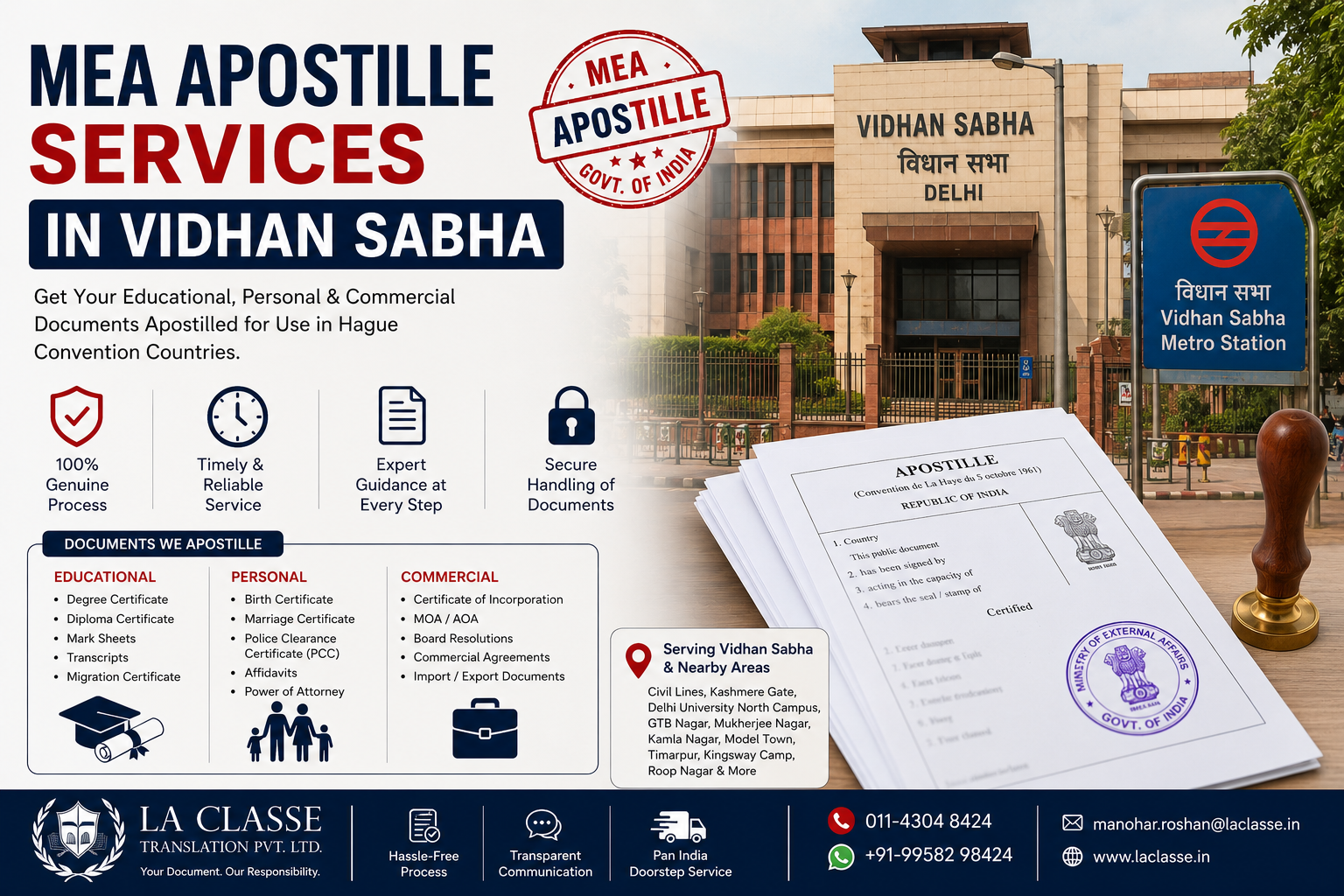
International opportunities have become more accessible than ever before. Every year, students secure admissions to foreign universities, professionals accept overseas employment offers, families begin immigration journeys, and businesses expand into international markets. While these opportunities are exciting, they all have one important requirement in common—properly authenticated documents that meet the destination country's legal and administrative standards.
For many applicants living in and around Vidhan Sabha, preparing documents for international use can initially feel confusing. Questions such as Which documents require apostille?, Is certified translation necessary?, Will my degree certificate need additional verification?, and How does the Ministry of External Affairs (MEA) authentication process work? are among the most frequently searched by applicants before beginning their documentation journey.
If you are searching for reliable MEA Apostille Services in Vidhan Sabha, this guide has been created to answer those questions in a practical and easy-to-understand manner. Rather than focusing only on the authentication procedure, we'll explain why apostille is required, who commonly needs it, which documents are usually involved, and how careful preparation can help reduce unnecessary delays.
Whether you live near Vidhan Sabha Metro Station, Civil Lines, Raj Niwas Marg, Kashmere Gate, ISBT Kashmere Gate, Delhi University North Campus, Vishwavidyalaya, GTB Nagar, Mukherjee Nagar, Kamla Nagar, Model Town, Timarpur, Maurice Nagar, Kingsway Camp, Roop Nagar, Shakti Nagar, or nearby areas, understanding the documentation process before submitting your certificates can save both time and effort.
At La Classe Translation Pvt. Ltd., we regularly assist students, working professionals, families, exporters, entrepreneurs, and corporate clients with document authentication and certified translation requirements. Our focus is on helping applicants understand the process, reviewing documentation carefully, and providing guidance based on the purpose of the application rather than treating every case the same way.
Quick Answer
Applicants looking for MEA Apostille Services in Vidhan Sabha usually require authenticated educational, personal, or commercial documents before they can be accepted by foreign universities, employers, immigration authorities, or government institutions. Preparing the correct documents and understanding the verification process before submission can help avoid unnecessary delays and make international documentation much more organised.
What Are MEA Apostille Services?
An apostille is an official authentication issued by the Ministry of External Affairs (MEA), Government of India, for eligible public documents. It confirms the authenticity of the signature and seal on the document so that it can generally be recognised in countries that are members of the Hague Apostille Convention, subject to the receiving authority's requirements.
Many applicants assume that apostille simply means getting a government stamp. In reality, document authentication often involves several important stages, including document assessment, verification (where applicable), and ensuring that the correct document category is being submitted.
Professional MEA Apostille Services in Vidhan Sabha help applicants understand these requirements before the documentation process begins.
Depending on the purpose of your application, commonly authenticated documents include:
- Degree Certificates
- Academic Transcripts
- Birth Certificates
- Marriage Certificates
- Police Clearance Certificates (PCC)
- Medical Certificates
- Affidavits
- Power of Attorney
- Company Registration Documents
- Commercial Agreements
Preparing the right documents from the beginning helps minimise avoidable delays later in the authentication process.
Why Are More Applicants Around Vidhan Sabha Looking for Apostille Services?
The demand for international education, overseas careers, immigration, and global business has increased significantly over the last few years. As a result, more applicants from Vidhan Sabha and nearby areas now require professionally authenticated documents before submitting applications abroad.
The Vidhan Sabha area is strategically connected to several important educational, residential, and commercial locations in North Delhi. Students from nearby colleges, professionals working across Delhi NCR, and business owners frequently begin their international documentation process from this region because of its excellent connectivity through the Delhi Metro and major road networks.
Applicants from:
- Civil Lines
- Raj Niwas Marg
- Kashmere Gate
- ISBT Kashmere Gate
- Delhi University North Campus
- Vishwavidyalaya
- GTB Nagar
- Mukherjee Nagar
- Kamla Nagar
- Model Town
- Timarpur
- Maurice Nagar
- Kingsway Camp
- Roop Nagar
often require document authentication while applying for:
- Higher Education Abroad
- Overseas Employment
- Immigration
- Family Sponsorship
- Professional Licensing
- International Business Registration
Although each applicant has a different objective, one thing remains common—documents must be prepared carefully before they are submitted to the appropriate authority.
Who Usually Requires MEA Apostille Services in Vidhan Sabha?
Understanding who commonly requires apostille helps applicants determine whether the process is relevant to their own situation.
Students Planning to Study Abroad
Students from Delhi University North Campus, nearby colleges, and educational institutions around Vishwavidyalaya, Mukherjee Nagar, and GTB Nagar frequently require authenticated educational documents before applying for admissions, scholarships, student visas, or professional licensing overseas.
Common educational documents include:
- Degree Certificates
- Academic Transcripts
- Diploma Certificates
- Migration Certificates
- Mark Sheets
Different universities may request different combinations of documents, so reviewing admission requirements in advance is always recommended.
Working Professionals
Professionals relocating to countries such as Germany, France, Spain, Italy, Australia, the Netherlands, Portugal, or other Hague Convention member countries often need authenticated educational and personal documents as part of their employment process.
These may include:
- Degree Certificate
- Police Clearance Certificate (PCC)
- Experience Certificate
- Medical Certificate
- Professional Qualification Documents
Preparing these records before receiving a joining deadline helps reduce last-minute pressure.
Families Applying for Immigration
Families relocating abroad may need authenticated civil documents for visa applications, family sponsorship, overseas marriage registration, or legal formalities.
Frequently required documents include:
- Birth Certificate
- Marriage Certificate
- Affidavit
- Adoption Documents
- Identity-related Records
Documentation requirements vary depending on the destination country, making it important to verify the latest instructions before beginning the process.
Entrepreneurs and Businesses
International business expansion has also increased the demand for commercial document authentication.
Companies may require authenticated documents such as:
- Certificate of Incorporation
- Memorandum of Association (MOA)
- Articles of Association (AOA)
- Board Resolution
- Commercial Agreements
- Trademark Documents
Businesses preparing overseas registrations or partnerships often benefit from reviewing documentation requirements before submission.
Why Professional Guidance Makes a Difference
International documentation involves more than submitting original certificates. Every application has its own purpose, and every destination country may have different expectations regarding documentation.
Choosing experienced MEA Apostille Services in Vidhan Sabha allows applicants to better understand:
- Which document category applies to their application.
- Whether any preliminary verification is required.
- If certified translation is also needed.
- How supporting documents should be prepared.
- What practical steps can help avoid unnecessary delays.
This approach is particularly valuable for first-time applicants who may not yet be familiar with international documentation procedures.
As applicants begin organising their documents, another important question naturally follows. While understanding who requires apostille is helpful, many people still remain unsure about which documents actually need authentication, what supporting records should be prepared, and how the official verification process works before the Ministry of External Affairs issues an apostille. Understanding these practical aspects is often where the real documentation journey begins—and that's exactly what we'll continue exploring in the next section.
Understanding these practical aspects is often where the real documentation journey begins—and that's exactly what we'll continue exploring next.
Many applicants assume that once they have collected their original certificates, the apostille process can begin immediately. In practice, however, successful document authentication depends on much more than simply submitting a document. The document category, the purpose of your application, the destination country, and any preliminary verification requirements all play an important role in determining how the process moves forward.
This is why experienced MEA Apostille Services in Vidhan Sabha always recommend reviewing every document before initiating the authentication process. A little preparation at the beginning often helps applicants avoid unnecessary delays later, especially when important admission, visa, employment, or business deadlines are involved.
Documents Commonly Required for MEA Apostille Services in Vidhan Sabha
Educational, personal, and commercial documents each follow their own documentation pathway. Understanding which category your documents belong to is one of the first steps towards a smoother apostille process and helps applicants prepare more confidently for international requirements.
Whether you're a student from Delhi University North Campus, a professional living near Civil Lines, a family based around Kashmere Gate, or a business owner operating close to Raj Niwas Marg, identifying the correct document category before submission can save both time and unnecessary follow-ups.
Educational Documents
Educational certificates remain among the most frequently authenticated documents because they are commonly required for higher education, professional licensing, research programmes, and overseas employment.
Applicants usually require authentication for:
- Degree Certificate
- Academic Transcript
- Diploma Certificate
- Provisional Degree Certificate
- Migration Certificate
- Mark Sheets
- School Leaving Certificate
- Higher Secondary Certificate
- Technical Qualification Certificate
Students from colleges located around Delhi University North Campus, including those staying in Vishwavidyalaya, Mukherjee Nagar, GTB Nagar, Kamla Nagar, and Maurice Nagar, often begin arranging these documents soon after receiving admission offers from universities abroad.
Before initiating the authentication process, applicants should carefully verify that the information printed on their certificates matches their passport and other supporting records. Small discrepancies in names, dates of birth, or certificate details can sometimes lead to additional clarification requests during verification.
Personal Documents
Personal documents are generally required for immigration, dependent visas, overseas marriage registration, family sponsorship, legal procedures, and long-term residency applications.
Commonly authenticated personal documents include:
- Birth Certificate
- Marriage Certificate
- Police Clearance Certificate (PCC)
- Medical Certificate
- Affidavit
- Power of Attorney
- Divorce Decree
- Death Certificate
- Adoption Documents
- Name Change Certificate
Applicants searching for Document Apostille Services in Vidhan Sabha often require one or more of these documents depending on the purpose of their international application.
It is also advisable to confirm whether the receiving authority requires certified translation along with authenticated originals. Some organisations accept English-language documents, while others request officially translated versions before processing the application.
Commercial Documents
As businesses continue expanding beyond national boundaries, commercial document authentication has become increasingly important.
Companies located near Vidhan Sabha, Civil Lines, Kashmere Gate, Model Town, and surrounding business districts may require authenticated commercial records before establishing overseas partnerships, opening foreign offices, participating in international tenders, or completing legal registrations abroad.
Frequently authenticated commercial documents include:
- Certificate of Incorporation
- Memorandum of Association (MOA)
- Articles of Association (AOA)
- Board Resolution
- Commercial Agreements
- Import Documentation
- Export Documentation
- Trademark Registration Certificates
- Company Registration Records
Each commercial application has its own documentation requirements, so reviewing the destination country's expectations before submission helps businesses prepare more effectively.
Supporting Documents May Also Be Required
One of the most common misconceptions is that carrying the original certificate alone is enough.
In reality, depending on your document category and application purpose, additional supporting records may also be required during the documentation process.
These commonly include:
- Valid Passport Copy
- Government-issued Photo Identification
- Authorization Letter (if applicable)
- Supporting Academic Records
- Company Authorization Documents
- Visa-related Documents (where required)
- Additional Affidavits, if applicable
Preparing these documents in advance creates a more organised documentation file and helps reduce avoidable interruptions later in the process.
Understanding the Verification Process Before Apostille
An apostille is not usually the first step. Before eligible documents reach the Ministry of External Affairs, they may need to complete applicable verification requirements depending on the document category. Understanding this sequence helps applicants set realistic expectations and prepare their paperwork correctly.
Although the exact workflow depends on the type of document, the process generally follows a structured approach.
Initial Document Assessment
Every application begins with reviewing:
- Document Category
- Issuing Authority
- Purpose of Submission
- Destination Country
- Supporting Documentation
This stage helps identify missing information before the authentication process begins.
Applicable Verification
Certain educational, personal, or commercial documents may require verification from the appropriate authority before they become eligible for apostille.
Rather than assuming every certificate follows the same procedure, applicants should verify the specific requirements that apply to their document category.
Ministry of External Affairs Authentication
Once the required verification stages have been completed, eligible documents proceed for authentication by the Ministry of External Affairs (MEA).
The apostille issued by the MEA confirms the authenticity of the document for use in Hague Convention member countries, subject to the receiving institution's documentation requirements.
Is Certified Translation Required Before Apostille?
This is one of the most frequently asked questions by applicants around Vidhan Sabha and nearby areas.
The answer depends entirely on the country and organisation requesting your documents.
For example:
- A university may ask for both an apostilled degree certificate and a certified translation.
- An immigration authority may require translated personal documents together with authenticated originals.
- A foreign employer may request translated educational qualifications before completing the recruitment process.
- International businesses may require translated commercial agreements alongside authenticated company records.
Because every application is different, confirming these requirements before starting the documentation process helps applicants avoid duplicate work and unnecessary delays.
As applicants become familiar with the documentation requirements, another important aspect naturally comes into focus. Even when all the required certificates have been collected, many international applications are still delayed because of small but avoidable mistakes made before submission. Understanding what these common mistakes are—and learning how experienced documentation professionals help applicants avoid them—can make a significant difference to the overall documentation experience, which is exactly where we'll continue next.
Understanding what these common mistakes are—and learning how experienced documentation professionals help applicants avoid them—can make a significant difference to the overall documentation experience, which is exactly where we'll continue.
One important point worth remembering is that international documentation is rarely delayed because applicants lack the required certificates. More often, delays happen because documents are submitted without proper review, supporting records are incomplete, or applicants assume that every country follows the same authentication requirements. These are practical issues that can usually be avoided with careful preparation before the process begins.
For applicants looking for MEA Apostille Services in Vidhan Sabha, understanding these common challenges in advance can make the documentation journey far more organised and help reduce unnecessary follow-ups with universities, employers, immigration authorities, or overseas business partners.
Common Mistakes to Avoid Before Applying for MEA Apostille
Most documentation delays are caused by preparation mistakes rather than the apostille process itself. Reviewing your documents carefully, confirming destination-specific requirements, and organising supporting records before submission can significantly improve the overall documentation experience.
Whether you're a student near Delhi University North Campus, a professional living in Civil Lines, a family residing around Kashmere Gate, or a business owner operating close to Vidhan Sabha Metro Station, avoiding these common mistakes can help you move through the authentication process with greater confidence.
Waiting Until the Last Moment
This remains one of the most common reasons applicants experience unnecessary stress.
Students often begin preparing their documents only after receiving a university admission letter. Professionals may wait until an overseas employer requests authenticated certificates, while businesses sometimes delay documentation until international contracts are ready for execution.
Although deadlines vary, beginning the documentation process early generally provides sufficient time for:
- Document assessment
- Applicable verification
- MEA authentication
- Certified translation (where required)
- Final submission to the receiving authority
Planning ahead also gives applicants enough time to respond if additional supporting documents are requested.
Assuming Every Document Follows the Same Process
Another misconception is that all certificates follow an identical authentication pathway.
In reality, educational, personal, and commercial documents are often processed differently because each category may involve different verification requirements before becoming eligible for apostille.
For example:
- A university degree may require a different verification sequence than a birth certificate.
- A Police Clearance Certificate (PCC) may serve a completely different purpose from a commercial agreement.
- Business documents intended for overseas registration may require additional supporting records depending on the receiving country's regulations.
Understanding these differences before submission helps applicants prepare more accurately and avoid unnecessary revisions later.
Overlooking Small Errors in Important Documents
Applicants often focus on collecting certificates but forget to verify the information printed on them.
Before submitting documents through MEA Apostille Services in Vidhan Sabha, it's advisable to review:
- Full Name
- Date of Birth
- Parent's Name
- University Name
- Certificate Number
- Passport Details
- Company Information (where applicable)
Even minor inconsistencies can sometimes require clarification before authentication progresses further.
Taking a few minutes to review these details beforehand may prevent delays later in the documentation process.
Ignoring Certified Translation Requirements
Many international applications involve more than document authentication alone.
Applicants sometimes arrange apostille first and only later discover that the receiving university, employer, or immigration authority also requires certified translations.
For example:
- Universities may ask for authenticated academic certificates together with certified translations.
- Immigration authorities may request translated birth or marriage certificates alongside apostilled originals.
- Overseas employers may require translated educational qualifications before completing recruitment procedures.
- International companies may request translated commercial documents before executing legal agreements.
Reviewing the complete documentation checklist before beginning the process helps applicants prepare everything together rather than arranging services separately.
Practical Tips Before Starting the Documentation Process
After assisting applicants with international documentation across different categories, certain best practices consistently help make the process more efficient.
Organise Documents Category-Wise
Rather than carrying every certificate together, separate them into individual categories.
Educational Documents
- Degree Certificate
- Diploma
- Academic Transcript
- Mark Sheets
Personal Documents
- Birth Certificate
- Marriage Certificate
- Police Clearance Certificate
- Medical Certificate
- Affidavit
Commercial Documents
- Certificate of Incorporation
- Memorandum of Association
- Articles of Association
- Board Resolution
- Commercial Agreements
This simple approach allows documents to be reviewed more efficiently and makes it easier to identify anything that may still be missing.
Keep Original Documents in Good Condition
Original certificates should always be maintained carefully.
Avoid submitting:
- Torn certificates
- Damaged official seals
- Folded documents
- Incomplete pages
- Handwritten alterations
- Poor-quality photocopies in place of originals (where originals are required)
Properly maintained documents generally move through the review process more smoothly.
Confirm Destination Country Requirements
Applicants from Vidhan Sabha, Civil Lines, Delhi University North Campus, Mukherjee Nagar, GTB Nagar, Model Town, and nearby areas frequently prepare documents for countries such as Germany, France, Italy, Spain, Portugal, Australia, and the Netherlands.
Although many of these countries recognise apostilles under the Hague Convention, individual universities, employers, licensing authorities, and immigration departments may still request different supporting documents.
Checking the latest documentation requirements before submission is one of the simplest ways to avoid unnecessary revisions.
Why Professional Guidance Adds Value
International documentation involves several interconnected stages, and understanding how they fit together often makes the process much easier.
Experienced Document Apostille Services in Vidhan Sabha generally assist applicants by:
- Reviewing document eligibility before submission.
- Identifying missing supporting documents.
- Explaining verification requirements in simple language.
- Guiding applicants according to the purpose of their application.
- Coordinating documentation in an organised manner.
- Providing secure handling of original certificates.
- Keeping applicants informed throughout the documentation process.
This structured approach is particularly valuable for first-time applicants who may be unfamiliar with international documentation requirements.
As applicants gain a better understanding of document preparation and the common mistakes that can delay authentication, one final consideration naturally comes into focus. Beyond document verification and apostille itself, how do you identify a documentation partner that combines experience, transparency, secure document handling, and guidance tailored to your specific purpose? Choosing the right support can influence not only how smoothly the process moves forward but also how confidently you submit your documents for international use—and that's exactly what we'll bring together in the final section.
Understanding what these common mistakes are—and learning how experienced documentation professionals help applicants avoid them—can make a significant difference to the overall documentation experience, which is exactly where we'll continue now.
Although the apostille procedure follows an established process, many international applications are delayed long before the documents reach the Ministry of External Affairs. In most situations, the delay is caused by incomplete preparation, overlooked document details, or misunderstanding the destination country's documentation requirements. These are challenges that can often be prevented with careful planning and professional document assessment.
Whether you're applying for admission to a foreign university, preparing for an overseas job opportunity, completing immigration formalities, or expanding your business internationally, avoiding these common mistakes can save valuable time and help ensure a smoother documentation journey.
Common Mistakes to Avoid Before Applying for MEA Apostille Services in Vidhan Sabha
Many applicants believe the apostille process is delayed because of government procedures. In reality, incomplete documentation, incorrect information, and last-minute preparation are among the most common reasons why international applications take longer than expected. Reviewing documents carefully before submission significantly reduces these risks.
Applicants from Vidhan Sabha, Civil Lines, Raj Niwas Marg, Kashmere Gate, Vishwavidyalaya, Mukherjee Nagar, GTB Nagar, Kamla Nagar, Model Town, and surrounding North Delhi localities frequently prepare documents for overseas education, employment, immigration, and international business. Regardless of the destination country, careful preparation remains one of the most important parts of the process.
Waiting Until the Last Moment
This is one of the most common situations experienced by documentation professionals.
Students often begin arranging their documents only after receiving a university admission letter, while professionals start collecting certificates after an overseas employer requests them. Businesses may also delay preparing commercial documents until an international agreement is close to finalisation.
Starting early provides sufficient time for:
- Document assessment
- Verification (where applicable)
- MEA authentication
- Certified translation (if required)
- Final submission before official deadlines
Early preparation also provides flexibility if additional documents or clarifications are requested during the process.
Not Reviewing Document Accuracy
Applicants generally focus on collecting certificates but sometimes overlook the information printed on them.
Before beginning MEA Apostille Services in Vidhan Sabha, carefully verify details such as:
- Full Name
- Date of Birth
- Parent's Name
- Passport Details
- University Name
- Certificate Number
- Company Information (for commercial documents)
Even minor inconsistencies between documents may require clarification before authentication can proceed.
Assuming Every Country Has the Same Documentation Requirements
Another common misconception is that one documentation package is suitable for every country.
In reality, documentation requirements vary depending on the receiving authority.
For example:
- A university may require authenticated degree certificates together with academic transcripts.
- An employer may request educational certificates and a Police Clearance Certificate (PCC).
- Immigration authorities may require birth or marriage certificates.
- Commercial authorities may ask for company incorporation documents, board resolutions, or trademark certificates.
Reviewing the destination country's latest documentation requirements before beginning the process helps applicants prepare more accurately.
Overlooking Certified Translation Requirements
Many international applications involve more than apostille alone.
Depending on the destination country, applicants may also require certified translation of their documents.
For example:
- Educational certificates for overseas universities.
- Birth certificates for immigration.
- Marriage certificates for dependent visas.
- Commercial agreements for international business registration.
Planning apostille and certified translation together often creates a more organised documentation process and reduces the need for repeated submissions.
Practical Tips Before Starting the Apostille Process
Applicants who prepare their documents systematically usually experience fewer documentation issues.
Some practical recommendations include:
Organise Documents by Category
Separate your documents into:
Educational Documents
- Degree Certificate
- Academic Transcript
- Diploma
- Mark Sheets
Personal Documents
- Birth Certificate
- Marriage Certificate
- PCC
- Medical Certificate
- Affidavit
Commercial Documents
- Certificate of Incorporation
- MOA
- AOA
- Board Resolution
- Commercial Agreements
Keeping documents organised makes the review process more efficient.
Protect Original Certificates
Avoid submitting documents that are:
- Torn
- Damaged
- Folded
- Illegible
- Missing official seals
- Altered manually
Maintaining original documents in good condition helps avoid unnecessary verification queries.
Confirm Destination Country Requirements
Applicants from Vidhan Sabha, Civil Lines, Kashmere Gate, Delhi University North Campus, Vishwavidyalaya, and nearby areas frequently apply to countries such as Germany, France, Italy, Spain, Portugal, Australia, and the Netherlands.
Although these countries recognise apostilles under the Hague Convention, universities, employers, immigration authorities, and government departments may still have their own documentation requirements.
Checking these requirements before submission helps applicants prepare complete documentation from the beginning.
Why Professional Apostille Guidance Makes the Process Easier
International document authentication involves much more than submitting certificates for an official stamp. Understanding document eligibility, supporting documentation, verification requirements, and destination-specific expectations requires experience and careful planning. Professional guidance helps applicants avoid common mistakes while ensuring every stage of the documentation process is handled more efficiently.
Applicants searching for Professional MEA Apostille Services in Vidhan Sabha are often looking for more than convenience—they want confidence that their original documents are being reviewed properly and that the process is being explained clearly.
Experienced documentation professionals typically assist by:
- Reviewing educational, personal, and commercial documents before submission.
- Identifying missing supporting documents at an early stage.
- Explaining the authentication sequence in simple language.
- Providing guidance based on the applicant's destination country and purpose.
- Coordinating certified translation requirements where applicable.
- Ensuring secure handling of original documents throughout the process.
- Keeping applicants informed with transparent communication from start to finish.
This structured approach is particularly valuable for first-time applicants who may be unfamiliar with international documentation requirements.
Supporting Students, Professionals, Families, and Businesses Around Vidhan Sabha
As international mobility continues to increase, the demand for reliable documentation support has grown across North Delhi.
Applicants from:
- Vidhan Sabha Metro Station
- Civil Lines
- Raj Niwas Marg
- Kashmere Gate
- ISBT Kashmere Gate
- Delhi University North Campus
- Vishwavidyalaya
- GTB Nagar
- Mukherjee Nagar
- Kamla Nagar
- Model Town
- Kingsway Camp
- Timarpur
- Roop Nagar
- Maurice Nagar
- Shakti Nagar
regularly seek professional assistance for:
- Study Abroad Applications
- Overseas Employment
- Immigration & Family Sponsorship
- Professional Licensing
- International Business Documentation
- Commercial Expansion
Choosing experienced MEA Apostille Services in Vidhan Sabha allows applicants to understand the documentation process before submission instead of resolving avoidable issues afterwards.
By this stage, most applicants have a clear understanding of which documents require authentication, how the verification process works, and the common mistakes that can delay international applications. The final step is choosing a documentation partner who combines experience, transparency, secure document handling, and practical guidance throughout the entire authentication journey. Understanding what truly distinguishes a professional apostille service from an ordinary documentation provider is exactly where we'll bring everything together in the final section.
Understanding what truly distinguishes a professional apostille service from an ordinary documentation provider is exactly where everything comes together. While every applicant may have a different objective, the qualities they expect from a documentation partner are remarkably similar—accuracy, transparency, secure handling of original documents, and guidance that helps them move through the authentication process with confidence rather than uncertainty.
Whether you're a student preparing for university abroad, a professional accepting an international job offer, a family completing immigration formalities, or a business entering overseas markets, working with experienced Professional MEA Apostille Services in Vidhan Sabha can make the documentation journey significantly more organised from beginning to end.
Why Choosing Professional MEA Apostille Services in Vidhan Sabha Matters
International documentation is not simply about obtaining an apostille certificate. It involves understanding document eligibility, verification requirements, supporting documentation, and the expectations of the receiving university, employer, immigration authority, or commercial organisation. Professional guidance helps applicants prepare every stage correctly before submission.
Many applicants initially search for the nearest documentation office because they believe convenience is the most important factor. However, after speaking with experienced documentation professionals, they often realise that accurate guidance and proper document assessment are far more valuable than selecting the closest location.
Applicants looking for Professional MEA Apostille Services in Vidhan Sabha generally benefit from support that includes:
- Careful review of educational, personal, and commercial documents.
- Guidance based on the destination country and application purpose.
- Identification of supporting documents before submission.
- Assistance in understanding verification requirements.
- Secure handling of original certificates.
- Transparent communication throughout the documentation process.
- Coordination of certified translation requirements whenever applicable.
This structured approach allows applicants to prepare their documents with greater confidence while reducing the likelihood of avoidable delays.
Why Applicants Across Vidhan Sabha Prefer Professional Documentation Support
The Vidhan Sabha area is well connected to educational institutions, government offices, residential neighbourhoods, and commercial centres across North Delhi. As international education, overseas employment, and global business continue to grow, applicants increasingly look for documentation partners who understand both international requirements and local accessibility.
Students, professionals, entrepreneurs, and families from:
- Vidhan Sabha Metro Station
- Civil Lines
- Raj Niwas Marg
- Kashmere Gate
- ISBT Kashmere Gate
- Delhi University North Campus
- Vishwavidyalaya
- GTB Nagar
- Mukherjee Nagar
- Kamla Nagar
- Model Town
- Kingsway Camp
- Timarpur
- Roop Nagar
- Maurice Nagar
- Shakti Nagar
- Malka Ganj
- Sant Nagar
- Azadpur
regularly require professional assistance for:
- Higher Education Abroad
- Overseas Employment
- Immigration & Family Sponsorship
- Professional Licensing
- International Business Expansion
- Export & Commercial Documentation
Choosing experienced Professional Apostille Services in Vidhan Sabha allows applicants to understand the complete documentation process before submission rather than resolving avoidable issues afterwards.
How Certified Translation and Apostille Work Together
One of the most common misconceptions is that apostille and certified translation are the same service. In reality, they serve different purposes but are often required together for international documentation.
An apostille authenticates the document for international recognition, while a certified translation enables the receiving authority to accurately understand the document's contents.
For example:
- A university in Germany may require an apostilled degree certificate together with a certified translation.
- Immigration authorities may ask for translated birth or marriage certificates along with authenticated originals.
- Overseas employers may request translated educational qualifications before completing employment verification.
- Businesses entering international markets may require translated commercial agreements supported by authenticated company documents.
Planning these services together helps applicants complete their documentation in a more organised and efficient manner.
Why Choose La Classe Translation Pvt. Ltd.?
At La Classe Translation Pvt. Ltd., we understand that every authenticated document represents an important milestone. For one applicant, it may be the beginning of an international academic journey. For another, it could be the first step towards a global career, family relocation, or overseas business expansion.
Instead of focusing only on document submission, our team places equal importance on helping applicants understand the documentation process before it begins.
We regularly assist clients requiring:
- Professional MEA Apostille Services in Vidhan Sabha
- Apostille Services in Delhi
- Educational Document Apostille
- Degree Certificate Apostille
- Birth Certificate Apostille
- Marriage Certificate Apostille
- Police Clearance Certificate (PCC) Apostille
- Commercial Document Apostille
- Certified Translation Services
- Legal Translation Services
- Sworn Translation Services
- Embassy Documentation Assistance
Our documentation approach is based on:
- Comprehensive document assessment
- Ethical documentation practices
- Secure handling of original certificates
- Destination-specific guidance
- Transparent communication
- Responsive customer support
- Assistance tailored to educational, personal, and commercial documentation
By understanding each applicant's individual requirements, we aim to make international documentation clearer, more organised, and less stressful.
Frequently Asked Questions
What is MEA Apostille?
MEA Apostille is an official authentication issued by the Ministry of External Affairs (MEA), Government of India, for eligible public documents intended for use in Hague Apostille Convention member countries.
Who usually requires MEA Apostille Services in Vidhan Sabha?
Apostille services are commonly required by:
- Students applying to foreign universities.
- Professionals accepting overseas employment.
- Families applying for immigration or dependent visas.
- Business owners expanding internationally.
- Individuals submitting legal documents abroad.
Which documents commonly require apostille?
Frequently authenticated documents include:
- Degree Certificates
- Academic Transcripts
- Birth Certificates
- Marriage Certificates
- Police Clearance Certificates (PCC)
- Medical Certificates
- Affidavits
- Power of Attorney
- Commercial Documents
The exact requirements depend on the destination country and receiving authority.
Is certified translation mandatory?
Not always.
Whether certified translation is required depends on the university, employer, immigration authority, embassy, or government department requesting your documents. Applicants should always verify the latest documentation requirements before submission.
How can applicants avoid delays?
Applicants should:
- Review documents carefully.
- Keep supporting records ready.
- Verify destination-country requirements.
- Begin the documentation process well before deadlines.
- Seek professional guidance whenever they are uncertain about document eligibility or verification requirements.
Final Thoughts
Preparing documents for international use is much more than completing a formal requirement. Every authenticated certificate supports an important personal or professional objective—whether it is studying abroad, starting an international career, immigrating with family, pursuing professional licensing, or expanding a business globally.
Throughout this guide, we have explored how MEA Apostille Services in Vidhan Sabha help applicants understand document categories, verification procedures, supporting documentation, common mistakes, certified translation requirements, and the importance of professional guidance. By preparing documents carefully and understanding the process before submission, applicants can approach international documentation with greater confidence and fewer avoidable complications.
If your application also requires Certified Translation, Educational Document Verification, Commercial Document Authentication, or complete international documentation support, planning these services together often creates a more efficient workflow and reduces unnecessary delays.
At La Classe Translation Pvt. Ltd., we are committed to providing accurate information, ethical documentation practices, transparent communication, and dependable support for applicants across Vidhan Sabha, Civil Lines, Raj Niwas Marg, Kashmere Gate, Delhi University North Campus, Vishwavidyalaya, GTB Nagar, Mukherjee Nagar, Kamla Nagar, Model Town, and surrounding North Delhi areas.
Whether your goal is higher education, overseas employment, immigration, or international business, our experienced team is dedicated to helping you prepare your documents professionally so you can move forward with confidence.
Contact La Classe Translation Pvt. Ltd.
📍 Office Address
F-126, Aditya Arcade, Preet Vihar, Delhi – 110092
📞 Phone
011-4304 8424 | +91-99582 98424
📧 Email
manohar.roshan@laclasse.in
🌐 Website
https://www.laclasse.in
If you're looking for Professional MEA Apostille Services in Vidhan Sabha, certified translation, document authentication, or end-to-end international documentation assistance, our team is ready to guide you with a professional, secure, and transparent approach tailored to your specific requirements.