
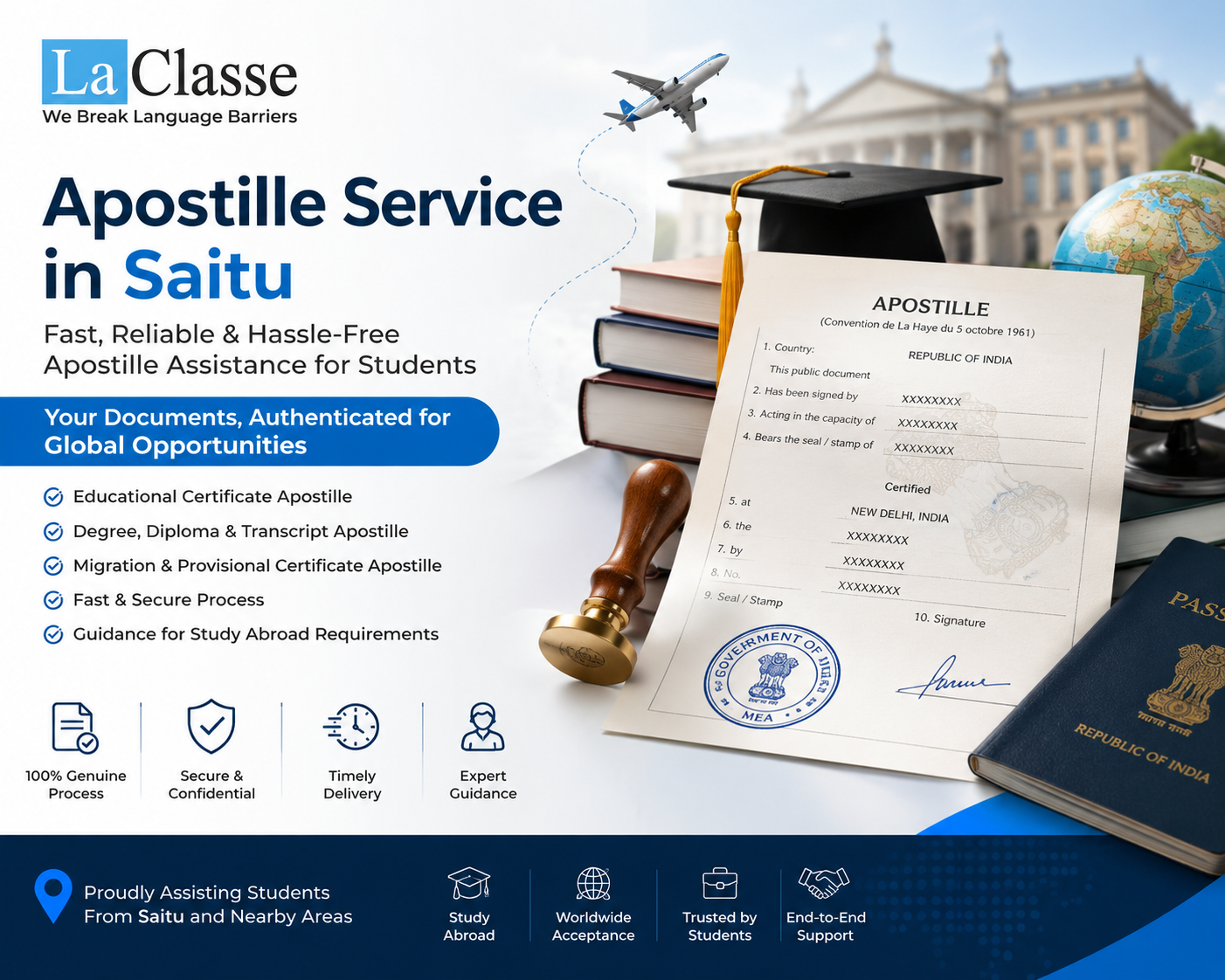
Studying abroad is an exciting opportunity for students who want to pursue higher education, experience a different academic environment, and build an international career. However, receiving an admission offer from an overseas university is only the beginning. Students must also prepare academic certificates, transcripts, marksheets, personal documents, and other records according to the requirements of the university, visa authority, or foreign institution.
For students from Saitu and nearby areas, document authentication can become an important part of this preparation. An apostille service in Saitu can help students understand which documents may require authentication, what supporting paperwork may be needed, and whether certified translation or additional legalisation is applicable.
The exact requirements vary according to the destination country, document type, university, course, and purpose of submission. Therefore, students should always begin with the official instructions provided by their overseas university and the relevant authorities.
Quick Answer: What Is an Apostille?
An apostille is an official form of authentication used for eligible public documents intended for use in another country that recognises the Hague Apostille Convention.
For students, documents that may potentially require authentication include:
- Degree certificates
- Diploma certificates
- Academic transcripts
- Marksheets
- Provisional certificates
- Migration certificates
- Birth certificates
- Affidavits
- Other educational or personal documents
However, not every document automatically needs an apostille. The requirement depends on the destination country, receiving institution, document type, and purpose.
Students searching for apostille services near Saitu should therefore first identify the exact documents requested by their university, immigration authority, embassy, or other receiving organisation.
Why Apostille Documentation Matters for Students in Saitu
International education involves more than meeting academic eligibility requirements. Foreign universities and authorities may need documents that establish a student's educational background, identity, or other personal information.
For example, a university may ask for authenticated academic certificates to confirm a student's previous qualification. A visa authority may request personal documents as part of an immigration application. In certain circumstances, authenticated documents may also be needed for scholarships, internships, professional registration, or future employment.
This makes proper document preparation an important part of the study-abroad journey.
Students from Saitu and surrounding areas can benefit from starting the documentation process well before the final university or visa deadline. Early preparation gives them enough time to:
- Collect original certificates
- Review university requirements
- Check destination-country requirements
- Identify documents requiring authentication
- Verify names and personal details
- Arrange certified translations where necessary
- Resolve discrepancies in certificates
- Maintain digital copies of important documents
A structured approach can reduce the risk of incomplete paperwork, incorrect documents, missing translations, or last-minute authentication requirements.
What Students Should Check Before Starting the Apostille Process
Before submitting documents for authentication, students should carefully review the instructions issued by their overseas university or relevant authority.
Important questions include:
- Which documents have been requested?
- Does the destination country accept apostilled documents?
- Is additional authentication or legalisation required?
- Does the university require certified translation?
- Are original certificates required?
- Are officially issued transcripts necessary?
- Do names and dates match across documents?
- What is the final submission deadline?
These checks become particularly important when documents have been issued by different schools, colleges, universities, or government authorities.
For example, a student's name on a degree certificate may have a different spelling from the passport. Similarly, dates or other personal information may vary between documents. Such discrepancies should ideally be investigated before authentication begins.
Correcting an issue early is generally easier than discovering it after documents have already entered the authentication process.
Apostille and Translation Are Different
Students sometimes assume that apostille and translation are the same process. They are not.
An apostille relates to authentication of an eligible public document for international use.
A certified translation converts the contents of a document into another language according to the requirements of the receiving institution or authority.
Depending on the destination country, a student may need:
Original Document → Applicable Authentication → Apostille, Where Required → Certified Translation, Where Required
The exact sequence can vary. Students should therefore follow the instructions of the receiving authority rather than assuming that the same process applies to every country.
For students looking for document authentication services near Saitu, understanding this difference can help prevent unnecessary processing and make the overall documentation process easier to manage.
Educational Documents That Students May Need for Apostille
Academic certificates are among the most important documents in an overseas education application. However, the exact documents requiring authentication depend on the university, destination country, academic level, and purpose.
Degree Certificate Apostille
A degree certificate confirms that a student has completed a particular academic programme from an educational institution.
A Degree Certificate Apostille may be required when an overseas university or authority specifically requests an authenticated qualification document.
It can become relevant for students applying for:
- Master's programmes
- Doctoral programmes
- Professional courses
- International academic programmes
- Overseas scholarships
- Professional registration
- Academic verification
Before submitting a degree certificate, students should check the full name, course title, university name, completion year, and certificate details.
If the information differs from the passport or another official document, the discrepancy should be investigated before authentication.
Diploma Certificate Apostille
Students with technical, vocational, or professional diplomas may also need to submit their qualifications abroad.
A Diploma Certificate Apostille can become relevant when a foreign university or authority specifically requests authentication of the qualification.
Diploma-related documents may include:
- Technical diploma certificates
- Vocational qualifications
- Professional diplomas
- Course completion certificates
- Supporting academic records
An apostille authenticates an eligible document; it does not decide whether the foreign university considers the qualification equivalent to its own educational standards.
The receiving institution remains responsible for determining whether the qualification meets its admission criteria.
Academic Transcript Apostille
An academic transcript provides a detailed record of a student's academic history. It may include subjects studied, grades, credits, semesters, and programme information.
Some overseas universities request transcripts along with degree certificates because transcripts provide additional information about academic performance.
An Academic Transcript Apostille may therefore be relevant if an overseas authority specifically requests an authenticated transcript.
Before submitting a transcript, students should verify:
- All pages are included
- The student's name is correct
- Grades and marks are visible
- Institution details are accurate
- The transcript is officially issued
- No supporting pages are missing
Students should also determine whether the university wants a consolidated transcript or individual semester records.
Marksheet Apostille
Marksheets provide detailed academic results and may form part of an international university application.
Depending on the institution, students may be asked for:
- Semester marksheets
- Annual marksheets
- Final marksheets
- Consolidated marksheets
- Examination records
A Marksheet Apostille may be applicable when an overseas authority specifically requests authenticated academic records.
Students should not automatically authenticate every marksheet they possess. Instead, they should confirm exactly which records are required.
Provisional Certificate Apostille
Students who have completed their studies but have not yet received their final degree may sometimes receive a provisional certificate.
Depending on the university's requirements, this document may serve as temporary evidence of qualification.
A Provisional Certificate Apostille may be relevant when the overseas institution specifically asks for authentication of the provisional document.
Students should confirm whether the receiving institution accepts a provisional certificate and whether a final degree certificate must be submitted later.
Migration Certificate Apostille
A migration certificate may be requested in certain academic circumstances, although it is not universally required for international applications.
If an overseas institution specifically requests authentication of the document, a Migration Certificate Apostille may be applicable.
Students should first confirm that the document is required rather than processing it simply because they have one.
Personal Documents That May Be Required
Academic documents are not necessarily the only records required for international education.
Depending on the destination and purpose, students may also need:
- Birth Certificate
- Passport
- Police Clearance Certificate
- Affidavit
- Name Change Certificate
- Medical Certificate
- Sponsorship-related documents
- Other supporting declarations
For example, a Birth Certificate Apostille may be relevant when an overseas authority specifically requests an authenticated birth record.
Similarly, an affidavit may require authentication for a particular declaration.
The requirement should always be confirmed with the relevant university, embassy, immigration authority, or receiving organisation.
Why Document Details Must Match
Students often collect documents issued at different stages of their education. Consequently, inconsistencies may appear between certificates.
Before starting authentication, students should compare:
| Details | Documents to Check |
|---|---|
| Full Name | Passport, degree, marksheets, birth certificate |
| Date of Birth | Passport, birth certificate, academic records |
| Institution | Degree, transcript, marksheets |
| Course Name | Degree, transcript, application |
| Completion Year | Degree, marksheets, transcript |
| Certificate Number | Original certificate |
| Parent Details | Relevant personal records |
A small spelling difference does not automatically mean that a document cannot be used. However, students should investigate discrepancies before beginning the authentication process.
Apostille Process for Students Studying Abroad
Once the required documents have been identified, students should understand the general authentication process.
Step 1: Identify the Destination Country
The first step is determining where the documents will be used.
Apostille requirements are connected to the destination country's rules and its participation in the Hague Apostille Convention.
Popular study destinations may include:
- Germany
- France
- Italy
- Spain
- Portugal
- Netherlands
- Australia
- New Zealand
- Other international destinations
Students should verify the requirements for their specific destination rather than assuming that every country follows the same process.
Step 2: Check the University’s Official Requirements
Students should obtain the latest document checklist from the university or relevant authority.
The checklist may specify:
- Required academic certificates
- Transcript format
- Certified copies
- Translation requirements
- Authentication requirements
- Submission format
- Application deadlines
One university may require only a degree certificate, while another may ask for a degree, transcript, and marksheets.
This is why students should identify the exact requirement before arranging Educational Certificate Apostille Services.
Step 3: Collect Original Documents
Depending on the requirement, students may need:
- Degree certificate
- Diploma certificate
- Academic transcript
- Marksheets
- Provisional certificate
- Migration certificate
- School certificates
- Birth certificate
- Other supporting records
Students should make clear digital copies of their original documents before submitting them for processing.
Step 4: Review the Documents
Students should carefully check:
- Full name
- Date of birth
- Institution name
- Course title
- Completion date
- Certificate number
- Document condition
- Completeness of pages
If an issuing institution has made an error, students should consider resolving it before starting authentication.
Step 5: Determine the Applicable Authentication
Different document categories can follow different authentication requirements.
Educational certificates, personal documents, and other records may not necessarily follow the same route.
When contacting an apostille service near Saitu, students should provide information such as:
- Document type
- Issuing institution
- Destination country
- Purpose
- University name
- Translation requirements
- Submission deadline
This information can help determine the appropriate documentation route.
Step 6: Complete Authentication and Apostille
Once the applicable requirements have been established, the document can proceed through the relevant authentication process.
Depending on the circumstances, this may involve:
- Degree Certificate Apostille
- Diploma Certificate Apostille
- Academic Transcript Authentication
- Marksheet Authentication
- Provisional Certificate Authentication
- Personal Document Authentication
Where applicable, an eligible document can then receive an apostille for international use in a country that recognises the Hague Apostille Convention.
What an Apostille Does and Does Not Do
An apostille authenticates an eligible document for international use.
However, an apostille does not:
- Guarantee university admission
- Guarantee visa approval
- Confirm academic equivalence
- Replace a required translation
- Replace university document verification
- Automatically make every document acceptable to every institution
The receiving university, immigration authority, or professional organisation remains responsible for deciding whether the document satisfies its requirements.
Apostille vs Legalisation vs Notarisation
These terms are sometimes confused, but they can refer to different processes.
Apostille
Used for eligible public documents intended for use in a country recognising the Hague Apostille Convention.
Legalisation
May apply where a different document authentication route is required for the destination country or purpose.
Notarisation
A notary may certify or attest certain documents or signatures according to applicable rules.
Getting a document notarised does not automatically mean that it is ready for international submission.
Students should identify the exact authentication route before submitting original certificates.
Certified Translation for Students
Translation can become necessary when the receiving university or authority requires documents in a particular language.
Depending on the destination, students may be asked for:
- Certified translation
- Legal translation
- Sworn translation
- Notarised translation
- Translation by an approved translator
An apostille does not automatically translate the document.
Students looking for apostille and translation services near Saitu should provide the destination country's requirements and university instructions before arranging translation.
Apostille Requirements for Popular Study Destinations
European Countries
European destinations remain popular among Indian students. Students may apply to universities in Germany, France, Italy, Spain, Portugal, the Netherlands, Austria, Belgium, and other countries.
However, there is no single documentation procedure that automatically applies to every European university.
The institution may specify requirements relating to:
- Academic certificates
- Transcripts
- Certified copies
- Translation
- Authentication
- Visa documentation
Students should follow the specific instructions issued by their university.
Australia and New Zealand
Australia and New Zealand are also popular destinations for international students.
Students may need documents such as:
- Degree certificates
- Diplomas
- Academic transcripts
- Marksheets
- Identity documents
- Supporting certificates
Whether authentication is required depends on the specific university or authority.
Students should also keep university admission requirements separate from visa requirements because the two processes can involve different documentation.
Apostille for Scholarships and Professional Courses
Some students apply for scholarships alongside university admission.
Scholarship organisations may request academic records to verify eligibility and educational performance. If authentication is specifically requested, students should follow the scholarship provider's instructions.
Similarly, students pursuing professional courses may need authenticated academic records for both the university and a professional organisation.
This can occur in fields such as:
- Engineering
- Healthcare
- Education
- Management
- Law
- Technical professions
An apostille alone may not satisfy professional registration or recognition requirements.
Apostille vs Academic Credential Evaluation
This distinction is particularly important for international students.
An apostille authenticates an eligible public document for international use.
Academic credential evaluation examines a qualification and determines how it compares with another educational system or qualification framework.
Therefore:
Apostille ≠ Academic Equivalence
A student may have an appropriately apostilled degree and still need an academic evaluation if the receiving university or professional body requests one.
How to Choose Apostille Services in Saitu
Students comparing apostille services in Saitu should consider more than price.
1. Experience With Educational Documents
A provider familiar with degrees, diplomas, transcripts, marksheets, and provisional certificates can be useful for student applications.
2. Clear Process Explanation
The provider should explain the general stages involved, such as:
Document Review → Verification, Where Required → Authentication → Apostille → Translation, Where Required → Final Submission
The exact process can vary depending on the document and destination.
3. Transparent Communication
Students should know:
- What documents are required
- What supporting information is needed
- What stage their documents are at
- How completed documents will be returned
- Whether translation is necessary
4. Secure Handling of Original Certificates
Educational certificates are important records. Students should understand how originals will be handled.
Before submitting originals, keep:
- Scanned copies
- A document list
- Relevant university instructions
- Service-related records
Common Problems That Can Delay Student Documents
Several avoidable issues can complicate international documentation.
Incorrect Name Spelling
Different spellings across passport and certificates may require clarification.
Missing Pages
An incomplete transcript or damaged document can cause processing issues.
Wrong Document Format
A university may request a consolidated transcript while the student provides separate marksheets.
Missing Translation
A student may complete authentication and later discover that a certified translation is also required.
Unclear Destination Requirements
Requirements can differ between countries and institutions.
Last-Minute Processing
Starting close to the university deadline leaves little time to correct errors.
Early planning can significantly reduce these avoidable complications.
Student-Focused Apostille Checklist
Before submitting documents, students can use this checklist.
Academic Documents
- Degree certificate
- Diploma certificate
- Academic transcript
- Marksheets
- Provisional certificate
- Migration certificate
- School certificates, where required
Personal Documents
- Passport
- Birth certificate
- Police clearance certificate, where required
- Affidavit, where applicable
- Name-change documents, where applicable
Verification
- Destination country confirmed
- University requirements reviewed
- Names checked
- Dates checked
- Original documents available
- Digital copies created
Translation
- Required language confirmed
- Certified translation requirement checked
- Translation format verified
Submission
- Deadline recorded
- Documents organised
- Copies retained
- Final documents reviewed
Why Students Should Start Early
The study-abroad process includes many deadlines beyond university admission.
Students may need to complete:
- Document authentication
- Certified translation
- University enrolment
- Visa application
- Financial documentation
- Accommodation arrangements
- Travel planning
- Insurance requirements
- Other immigration formalities
Starting the authentication process early provides time to address unexpected issues.
For students searching for apostille services near Saitu, early consultation can be particularly helpful when multiple educational certificates need to be reviewed.
Final Advice for Students From Saitu
Students preparing to study abroad should treat apostille as one part of a larger international documentation process.
Before submitting documents, students should:
- Confirm the destination country.
- Review the university's official checklist.
- Identify the exact documents required.
- Check names and personal details.
- Confirm whether authentication is necessary.
- Check whether certified translation is required.
- Keep digital copies of all documents.
- Understand the applicable process.
- Start well before the deadline.
- Review completed documents before submission.
Choosing professional documentation assistance can make the process easier to organise, particularly when several academic certificates, personal documents, and translations are involved.
Contact La Classe Translation Pvt. Ltd.
Students who need assistance with MEA Apostille Services, Educational Certificate Apostille, Degree Certificate Apostille, Diploma Certificate Apostille, Document Authentication, Certified Translation, Legal Translation, and other international documentation requirements can contact La Classe Translation Pvt. Ltd.
📍 Office Address
La Classe Translation Pvt. Ltd.
F-126, Aditya Arcade,
Preet Vihar, Delhi – 110092
📞 Phone
011-4304 8424
+91-99582 98424
🌐 Website