
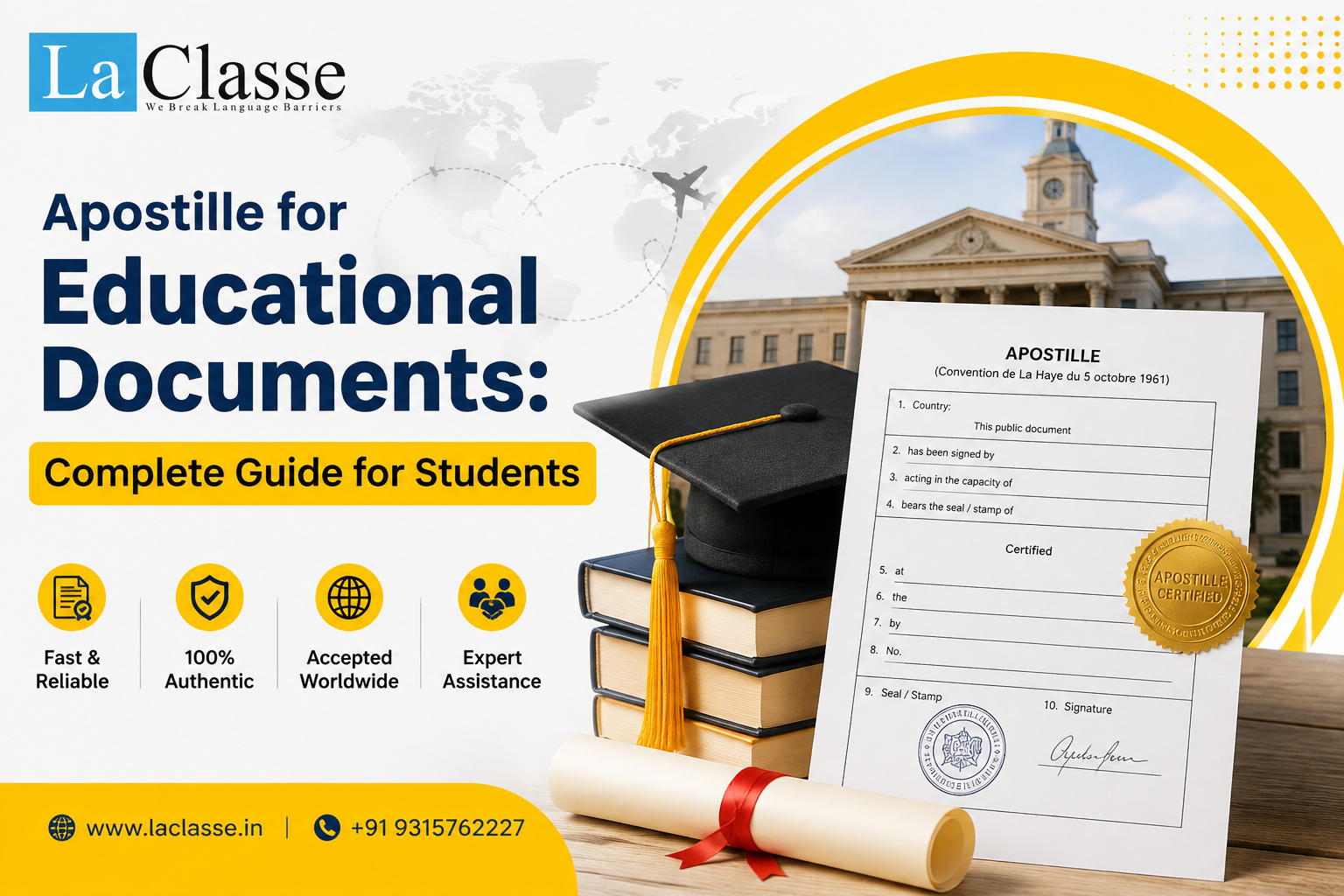
So, you've cracked your university admission, your visa paperwork is almost ready, and you're counting down the days to your new life abroad. But wait — have your educational documents been apostilled? If that word makes you pause, you're not alone. Thousands of Indian students every year get stuck at the last mile of their study-abroad journey simply because they didn't understand the apostille process for educational documents.
Whether you're heading to Germany for a master's degree, Canada for a diploma program, or Australia for undergraduate studies, your degree certificates, mark sheets, and transcripts need to be legally authenticated before they can be recognized in a foreign country. This authentication is called apostille, and getting it wrong — or leaving it too late — can delay your admission, visa approval, or even your flight.
In this comprehensive guide, we'll break down what apostille means, why it matters for students, which documents need it, the step-by-step process, and how you can get it done quickly and hassle-free with expert support from La Classe.
What Is Apostille? Understanding the Basics
An apostille is a form of document authentication recognized by countries that are members of the Hague Apostille Convention, 1961. It's essentially a certificate attached to your original document that verifies its authenticity — confirming that the signature, seal, or stamp on the document is genuine — so it can be legally used in another member country without further legalization.
For students, this means your degree certificate apostille, mark sheet apostille, or transcript apostille becomes a globally recognized proof of your academic credentials, accepted by universities, embassies, and immigration authorities abroad.
Apostille vs Attestation: What's the Difference?
This is one of the most common points of confusion among students. Here's a simple breakdown:
- Attestation involves multiple layers of verification (state HRD/education department, MEA, and sometimes embassy) and is required for countries that are not part of the Hague Convention.
- Apostille is a single-step, standardized authentication accepted by all Hague Convention member countries (over 120 nations, including the USA, UK, Germany, France, Australia, and most of Europe).
Knowing whether your destination country requires apostille or embassy attestation is the first step — and getting this wrong can waste weeks of valuable time.
Educational Document Apostille Matters for Students
If you're planning to study abroad, getting your educational documents apostilled is not just a formality. It is a crucial step that ensures your academic credentials are accepted by foreign universities and government authorities. Here's why it matters:
University Admission Verification
Most international universities require apostilled degree certificates, transcripts, and other academic documents to verify their authenticity before confirming your admission.
Essential for Student Visa Approval
Many countries, including Germany, France, Italy, and the Netherlands, require apostilled educational documents as part of the student visa application process. Missing this requirement can delay or even impact your visa approval.
Prevents Last-Minute Stress
The apostille process involves verification by government authorities and may take several days or weeks. Applying well in advance helps you avoid unnecessary delays and ensures you're ready before your departure.
Ensures Legal Recognition Overseas
An apostille certifies that your educational documents are genuine, allowing universities, employers, and immigration authorities in participating countries to legally recognize your qualifications without additional authentication.
Smooth Admission and Immigration Process
Having your documents apostilled in advance reduces paperwork issues, speeds up verification, and makes your transition to studying abroad much smoother and hassle-free.
Which Educational Documents Need Apostille?
The educational documents you need to apostille depend on the country you're moving to and the purpose of your application, such as higher education, a work visa, or permanent residency. However, the following documents are most commonly required:
- Degree Certificate
- Provisional Degree Certificate
- Mark Sheets or Grade Sheets (All Semesters/Years)
- Diploma Certificate
- Transfer Certificate (TC)
- School Leaving Certificate
- Migration Certificate
- Consolidated Mark Sheet
- PhD or Research Certificates
Check the Requirements Before You Apply
Every country, university, and embassy has its own documentation requirements. While some institutions may only ask for your degree certificate and transcripts, others may require additional academic records such as migration or transfer certificates.
To avoid delays in admissions, visa processing, or document verification, always confirm the required document checklist with your target university, employer, or embassy before starting the apostille process. Preparing the correct documents in advance can save time and ensure a smooth application experience.
Step-by-Step Apostille Process for Educational Documents in India
Getting your educational documents apostilled involves multiple stages of verification before they are accepted internationally. Here's a simple breakdown of the process:
Step 1: State HRD Attestation
The first step is verification by the State Human Resource Development (HRD) Department or the relevant State Education Department where your university, college, or education board is located. This confirms that your educational documents are authentic and eligible for further legalization.
Step 2: SDM Attestation (Where Applicable)
In certain states or for specific document types, Sub-Divisional Magistrate (SDM) Attestation may be accepted as an alternative to HRD attestation. The applicable route depends on the issuing authority and the destination country's requirements.
Step 3: MEA Apostille
After the state-level verification is completed, your documents are submitted to the Ministry of External Affairs (MEA), Government of India, the only authority authorized to issue an Apostille certificate in India. The MEA affixes an official Apostille sticker, making your educational documents legally valid for use in Hague Convention member countries.
Step 4: Documents Ready for International Use
Once the MEA Apostille is complete, your educational documents are officially recognized abroad and can be used for:
- University admissions
- Student visa applications
- Employment opportunities
- Professional licensing
- Immigration and permanent residency processes
- Embassy and government verification
Common Mistakes Students Make During Apostille
Even a small mistake during the apostille process can lead to delays in university admissions, student visa approvals, or document verification. Avoid these common pitfalls to ensure a smooth experience:
- Starting the Process Too Late
Waiting until the last few weeks before your departure can create unnecessary stress. Since apostille processing may take several working days, it's always best to apply well in advance. - Skipping HRD Attestation
Many students mistakenly approach the Ministry of External Affairs (MEA) directly. However, educational documents usually require State HRD Attestation (or SDM attestation where applicable) before they are eligible for an apostille. - Submitting Incomplete Documents
Missing mark sheets, provisional certificates, or other required academic records can delay the verification process. Always double-check that your document set is complete before submission. - Ignoring Destination Country Requirements
Every country has its own documentation rules. Some require an apostille, while others may need embassy attestation instead. Verifying the specific requirements beforehand helps prevent unnecessary delays. - Choosing Unverified or Unreliable Agents
Entrusting your original educational documents to inexperienced or unauthorized service providers can increase the risk of delays, document mishandling, or even fraud. Always choose a reputable and experienced apostille service provider.
Countries That Accept Apostilled Educational Documents
An apostille issued by the Ministry of External Affairs (MEA), Government of India is recognized by countries that are members of the Hague Apostille Convention. This means your educational documents can be accepted abroad without requiring additional legalization from an embassy or consulate.
Some of the most popular study and work destinations that accept apostilled educational documents include:
- United States of America (USA)
- United Kingdom (UK)
- Germany
- France
- Italy
- Spain
- Australia
- Netherlands
- New Zealand
- South Korea
- South Africa
Why This Matters
If you're planning to study, work, or migrate to any Hague Convention member country, an apostille helps ensure your educational documents are legally recognized by:
- Universities and educational institutions
- Immigration and visa authorities
- Employers and licensing bodies
- Government departments and public authorities
This simplifies the document verification process and saves you from additional legalization procedures.
Important Note: Countries such as the United Arab Emirates (UAE), Qatar, Saudi Arabia, Kuwait, China, and several others are not members of the Hague Apostille Convention. For these destinations, educational documents generally require Embassy or Consular Attestation instead of an apostille. Always verify the latest documentation requirements with the respective embassy, university, or employer before beginning the process.
How Long Does Apostille Take and What Does It Cost?
The time and cost of getting your educational documents apostilled can vary depending on several factors. Understanding these in advance helps you plan your university admission or student visa application without unnecessary delays.
Factors That Affect Apostille Processing Time and Cost
- State of Document Issuance
Processing timelines differ from state to state, as each State HRD Department follows its own verification procedures. - HRD Attestation Status
If your documents have already been verified by the State HRD or SDM, the apostille process is usually faster. If HRD attestation is still pending, additional processing time will be required. - Type and Number of Documents
Whether you're submitting a single degree certificate or multiple documents such as mark sheets, transcripts, and diplomas, the overall processing time and cost may vary. - Normal vs. Express Processing
Many service providers offer both standard and expedited processing options. While express services can reduce turnaround time, they may involve additional charges.
Typical Processing Time
In most cases, the complete apostille process for educational documents takes 7 to 20 working days, depending on the issuing state, verification requirements, and document volume. During peak admission and visa seasons, processing may take slightly longer.
Get Transparent Pricing and Timely Assistance
Choosing a trusted consultancy like La Classe helps make the process simple and hassle-free. From document verification and HRD attestation to MEA apostille, experienced professionals provide clear guidance, accurate timelines, and transparent pricing with no hidden charges. This allows you to focus on your study abroad plans while ensuring your documents are processed correctly and on time.
Why Choose La Classe for Your Apostille Needs?
Planning to study abroad is exciting, but managing document verification, HRD attestation, and MEA apostille can quickly become overwhelming. Instead of navigating multiple government departments and complex procedures on your own, let La Classe Translataion Pvt. Ltd simplify the process from start to finish.
With years of experience assisting students across India, La Classe provides reliable apostille and attestation services, ensuring your educational documents are processed accurately and on time. Whether you're applying for university admission, a student visa, or higher education overseas, our team is here to guide you every step of the way.
Why Students Trust La Classe
- ✅ Complete end-to-end assistance for educational document apostille
- ✅ Expert guidance on HRD Attestation, SDM Attestation, and MEA Apostille procedures
- ✅ Fast, transparent, and hassle-free document processing
- ✅ Personalized support based on your destination country's requirements
- ✅ Assistance with student visas and study abroad documentation
- ✅ Dedicated customer support to keep you informed throughout the process
- ✅ Trusted by students for accurate documentation and timely service
Make Your Study Abroad Journey Stress-Free
Don't let paperwork stand between you and your dream university. From document verification to final apostille, La Classe takes care of the entire process so you can focus on admissions, visa preparation, and your upcoming journey abroad.
Contact La Classe Today
Visit Us
F-126, Aditya Arcade, Preet Vihar, Delhi – 110092
Call Us
011-4304 8424
+91-99582 98424
Email Us
manohar.roshan@laclasse.in
Ready to Get Started?
Book your FREE consultation with La Classe today and let our experts handle your educational document apostille with professionalism, speed, and complete peace of mind. Start your study abroad journey with confidence while we take care of the documentation.
Frequently Asked Questions (FAQs)
1. What is the difference between apostille and attestation?
Apostille is a single-step authentication accepted by Hague Convention member countries, while attestation involves multiple verification layers and is required for non-member countries.
2. How long does apostille of educational documents take in India?
It typically takes 7 to 20 working days, depending on the state and document type, though timelines can vary based on HRD processing speed.
3. Is HRD attestation mandatory before MEA apostille?
Yes, for most educational documents, state HRD (or SDM) attestation is a mandatory step before the Ministry of External Affairs issues the apostille.
4. Can I apostille my documents myself, or do I need an agent?
While it's technically possible to do it yourself, the multi-department process can be time-consuming and confusing. Professional consultants like La Classe simplify the process and reduce errors.
5. Do all countries accept apostilled documents?
No. Only countries that are signatories to the Hague Apostille Convention accept apostille. Non-member countries require embassy attestation instead.
6. What documents are commonly required for student apostille?
Degree certificates, mark sheets, provisional certificates, transfer certificates, and migration certificates are among the most commonly apostilled documents for students.
7. Can La Classe help with both apostille and study-abroad counseling?
Yes! La Classe offers complete support — from document apostille and attestation to university selection and visa guidance — all under one roof.
Final Thoughts
Getting your educational documents apostilled is not just a bureaucratic formality it's a critical step that determines whether your study-abroad dream stays on track or hits unexpected roadblocks. The earlier you start, the smoother your journey will be.
If you're feeling overwhelmed by the process, you don't have to navigate it alone. La Classe is here to guide you through every step from HRD attestation to final MEA apostille so you can focus on what matters most: preparing for your new academic adventure abroad.
📞 Call La Classe at 011-4304 8424 / +91-99582 98424 or visit us at F-126, Aditya Arcade, Preet Vihar, Delhi-110092 to get started today!